
Showing posts with label Bees. Show all posts
Showing posts with label Bees. Show all posts
Wednesday, 23 May 2018
Something Old and Something New for Bees
I've been a busy old blogger, and I'm feeling terribly ashamed that my blog has been forced to take a back seat while I run around willy-nilly, doing other stuff. I have missed being part of this wonderful community and I'm very happy to be back. There will be a longer, more photo-packed post later in the week, but in the meantime, if you would be kind enough to click on the link, you will find a piece about wonderful pollinator-friendly flowers at the RHS Chelsea Flower Show 2018. I hope you enjoy it.


Wednesday, 15 February 2017
February Flowers for Bees
While weeding a border yesterday, I was dragged from my winter torpor by a passing bee. Without a second thought for the hot drink I had been promising myself, I pursued the bee to see where it might be heading.
 There is plenty on the menu for early bees. Sitting prettily just above the surface of the soil are snowdrops, Crocus and Iris reticulata. Hellebores hang their heads shyly, as if scared to be noticed. Who can blame them when they are towered over by winter flowering shrubs pumping out great nostril-loads of scent and screaming for attention?

 |
| Snowdrops growing through Ivy. A match made in heaven |
I do love a scented shrub. At the moment, the sweetest of the fragrance factories are the shrubby honeysuckles, Lonicera fragrantissima and Lonicera x purpusii 'Winter Beauty'. Flowering from January to March in my garden, they are a valuable source of nectar for early bumble bees. Delicate creamy-white flowers hang on almost leafless branches. Their scent is not as heady as Sarcococca which is belting out fragrance at the moment, but Lonicera certainly packs enough of a punch to get attention.

 |
| Crocus brightening up the car park border |

I am joining with other bloggers around the world to celebrate Garden Bloggers' Bloom Day. Why not pop over to http://www.maydreamsgardens.com and see what is blooming in gardens around the globe?
Thursday, 15 September 2016
Twenty-First-Century Gardeners
The twenty-fifth anniversary of the internet set me thinking about the ways in which technology has impacted gardeners' lives. Once upon a time I gardened in isolation and on occasions I was fortunate to share my enthusiasm for plants with 3 elderly gardeners. I will be forever grateful for their company, encouragement, advice, seeds and cuttings. Twenty-first-century gardening needs not be a solitary experience. I might garden alone, but within seconds I can share my latest horticultural triumph or crop failure with thousands of fellow gardeners and receive advice, support, sympathy, and on those rare occasions when the going is good, a virtual pat on the back.
 |
| Ulting Wick Garden 2015 |
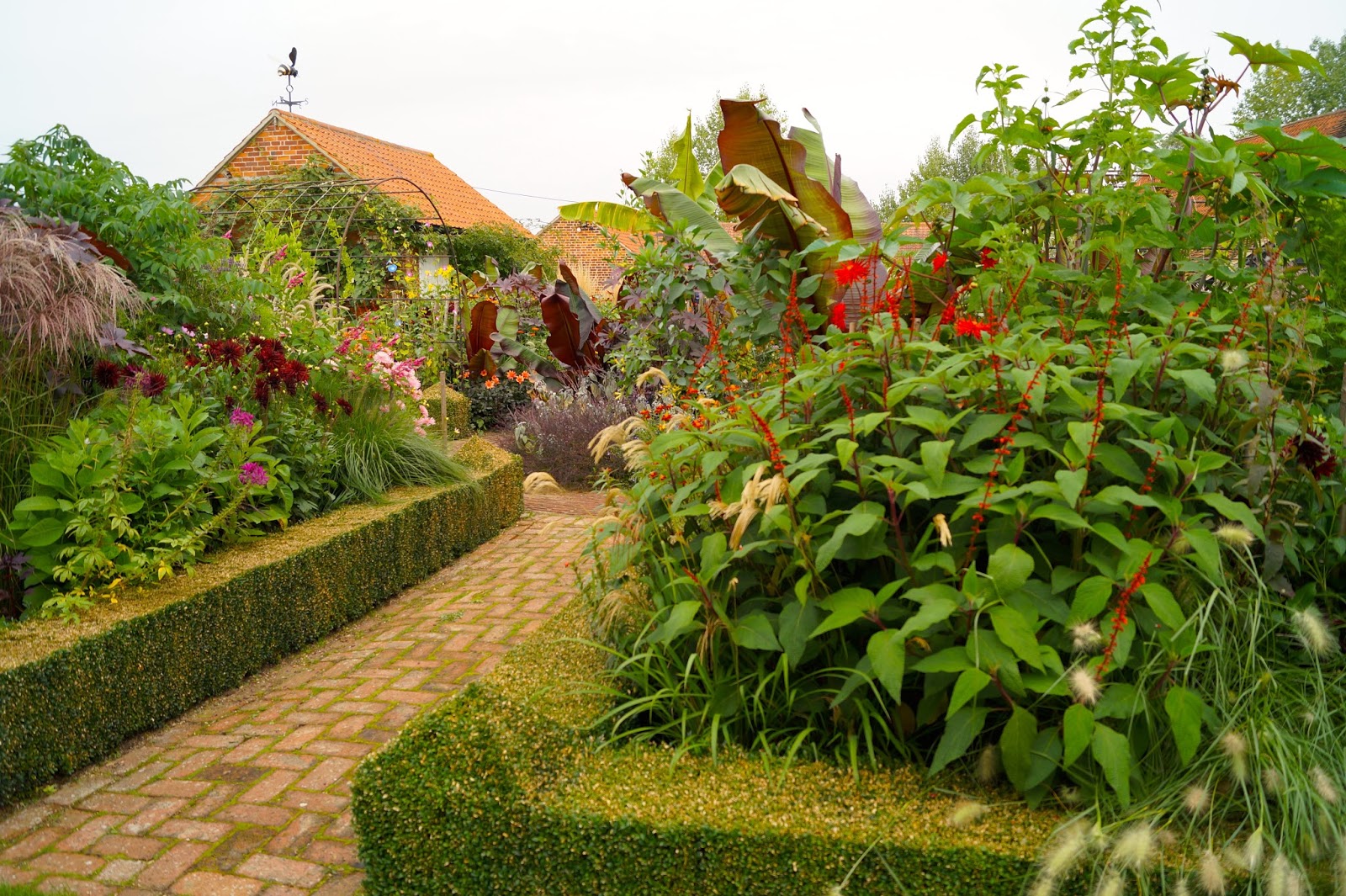
If your nearest and dearest are not nuts about gardening, meeting fellow gardeners and spending a few hours indulging in plant talk is a great luxury. In the UK, members of All Horts, an online group, arrange garden visits and invite fellow members to join them. It was during one such visit to Philippa Burrough’s wonderful garden at Ulting Wick in Essex, that I met Persicaria orientalis. I also met gardening enthusiast and fellow Twitterer, @ToBoldlyGrow, who admired the Persicaria in Philippa's garden and decided to start some from seed. Earlier this year, along with other wonderful plants which he had grown, he gave me some Persicaria orientalis.
 |
| Ulting Wick Garden 2015 |
 |
| Persicaria orientalis at Le Grys Farm |
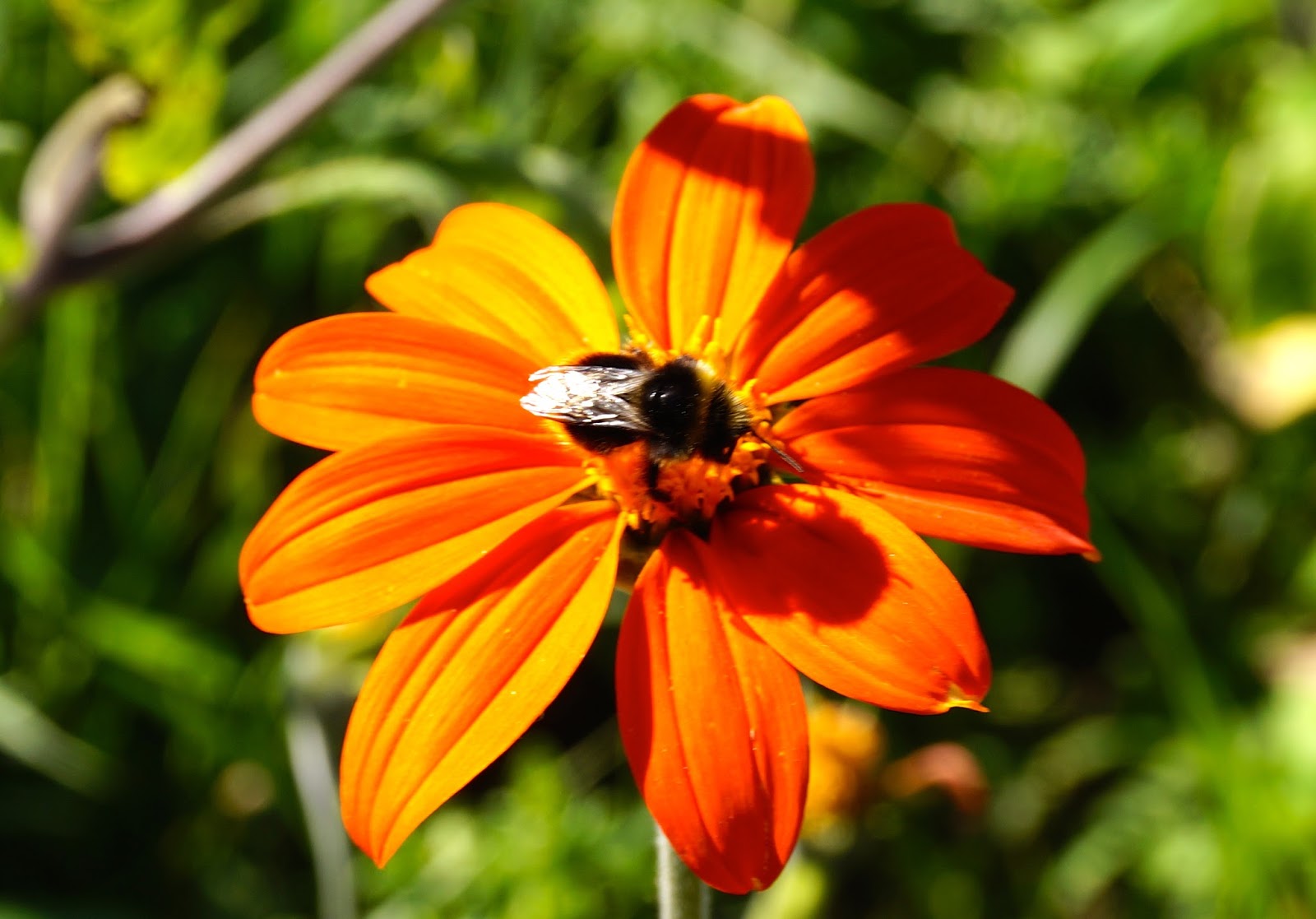 |
| Tithonia 'Orange Sunshine' at Le Grys Farm |
 |
| Ulting Wick Garden 2015 |
 |
| Ulting Wick Garden 2015 |
 |
| Ulting Wick Garden 2015 |
The first social media site was launched in 1997; blogging also dates back to the '90s. My children were born in the twenty-first century. They are teenagers who have never known a world without the internet, social media, or blogging. Like many families, we have rules about mobile phone manners, but at some time every day, I will see them with their heads bowed over their phones as they plan their social lives and share experiences with their friends far away, and I wonder how they could have ever managed without the internet. Then I look at myself and wonder how on earth I survived without it for so long.
I am linking this post to Garden Bloggers' Bloom Day to share the joys of Persicaria orientalis and Tithonia 'Orange Sunshine', which are both blooming their socks off in my garden at the moment. Why not pop over to http://www.maydreamsgardens.com/ to see what is blooming elsewhere around the globe?
More information about the garden at Ulting Wick may be found at http://www.ultingwickgarden.co.uk/
The Independent Plant Nurseries Guide: http://independentplantnurseriesguide.uk/
Jason blogs at https://gardeninacity.wordpress.com/ and James may be found at
https://reflectionsonthedewpond.wordpress.com/
More information about the garden at Ulting Wick may be found at http://www.ultingwickgarden.co.uk/
The Independent Plant Nurseries Guide: http://independentplantnurseriesguide.uk/
Jason blogs at https://gardeninacity.wordpress.com/ and James may be found at
https://reflectionsonthedewpond.wordpress.com/
Wednesday, 6 July 2016
Perennial Basil
Hilarius, the French physician, claimed that sniffing basil had led to a scorpion breeding in the brain of an acquaintance. I don't know about you, but I have buried my nose into the King of Herbs on many occasions and have never, as yet, noticed scorpions in my brain, breeding, or otherwise.


My passion for growing basil began in London where an Italian neighbour's garden was the source of a bountiful supply of fresh, juicy, sun-ripened tomatoes and delicious basil. He gave me my first basil plant and I quickly became hooked on growing culinary herbs. The thrill of harvesting fresh herbs never diminishes. I keep the plants close to the kitchen door so that I can grab a handful without bothering to put on my shoes. I also grow lettuce and tomatoes there in the hope that I might reach for salad instead of a chocolate bar (there is more chance of basil inducing brain-breeding scorpions).
 |
| The Salad Bar (sadly, the chocolate bar is no longer with us) |
Greeks and Romans would curse when they sowed basil seeds as they believed that it helped germination. When seeds stick to my hands rather than depositing themselves onto the compost, I call them names. It is hardly in the same league as a jolly good curse, so I have to take other precautions, such as sowing into modules, which does much to prevent death from damping off. I supplement home-sown insulted seeds with plant purchases if I see one which tickles my fancy. There are so many to choose from: cinnamon, lemon, lime, sweet or spice, Thai, Greek, Marseillais and Neopolitana, not forgetting the sumptuous purples, which may or may not be ruffled.
 |
| Spot the purple basil purchase |
The key requirements of basil are warmth and well-drained, rich soil. I grow the plants in containers placed in sheltered corners which receive midday sun. Basil can be given to sulking if it goes to bed with wet feet, which is perfectly understandable (I don't like my feet to be cold, let alone wet), so water basil by noon.
One of my ongoing gardening challenges is to keep the kitchen supplied with fresh herbs over winter. Some, such as rosemary, are a doddle, but others, basil among them, are trickier, especially without a greenhouse. The solution might be 'African Blue' basil (Ocimum 'African Blue'), a half hardy perennial which is sterile. Since it doesn’t go to seed, I guess that it will not have that irritating habit of ceasing leaf production every time it sends up a flower stem, which is as well because the flowers are beautiful and delicious (I nibbled a few after I took the photos).
 |
| Ocimum 'African Blue' |
While 'African Blue' certainly tastes of basil, it does not have quite the same flavour as the more commonly grown annuals. It does, however, have the distinct advantage of being perennial, so it may very well supply me with leaves earlier than the annual forms if I get it into my sunny office before the first frosts. Imagine how much basil I will be sniffing at my desk! If the perennial basil experiment works and Hilarius was right, we may very well be facing a massive UK scorpion infestation in 2017. It will make a change from slugs.
Wednesday, 15 June 2016
Prince Charles, The Smiths and a Passion for Podcasts
There was a time when I would have cranked up the volume on my car cassette player and sung my heart out to the strains of The Smiths. These days, although I am still prone to a spot of singalongaSmiths while driving, I am more likely to be clinging onto every word of a gardening podcast. My addiction to podcasts is interfering with my social life. Lingering post-lift conversations are a thing of the past as passengers are hastily disgorged from my vehicle so that I can settle selfishly into Gardeners' Question Time and similar treasures.


*Just in case you are too young to remember.... https://www.youtube.com/watch?v=1PV4eiDi12w
Prince Charles on Gardeners' Question Time http://www.bbc.co.uk/programmes/b074zy95
I am joining with http://www.maydreamsgardens.com/ for Garden Bloggers' Bloom Day. Why not head over there and see what is blooming in June around the globe?
Prince Charles on Gardeners' Question Time http://www.bbc.co.uk/programmes/b074zy95
I am joining with http://www.maydreamsgardens.com/ for Garden Bloggers' Bloom Day. Why not head over there and see what is blooming in June around the globe?
Monday, 4 April 2016
The Great Garden Throwback
I spent much of my childhood viewing gardens upside down. If I wasn't careering around the lawn perfecting cartwheels, I might be socialising over a weather-related handstands game which was snappily named Snow, Rain, Thunder, Lightning. The rules elude me, but I do remember that a handstand with one leg at a jaunty angle signified a lightning fork.


 I grow it in an area which was once a gravel drive. The soil is thin, impoverished and alkaline. The site is the most inhospitable part of the garden. It might face south, but it is also a frost pocket which can be exceptionally windy. Despite this, Aubretia flowers shrug off the frost and the plant holds itself together, blooms for weeks on end, and is a hub of bee action on a sunny day. Clipping it after flowering keeps it neat and tidy. It really is a valuable addition to my borders and leaves me wondering why on earth a plant of this calibre was so badly maligned?
 I would love to tell you with confidence that I purchased plants from the Cascade Series, but since I am relying on my memory and the plants are cascading nowhere, I am happy to be corrected. It is unsurprising that I mislaid the plant labels given the second part of reliving my childhood. I am no Beth Tweddle, but I gave it my best shot and my children were in awe of my handstand abilities. Of course, those might have been looks of horror on their faces, but for reasons of self-esteem, I will stick with awe. Despite reaching the dizzying heights of an almost perfect handstand (dizzying being the operative word - it took quite some recovering from), I shall not be attempting another handstand in the near future, not least because I swear it took a full week for all my internal organs to work their way back to where they started.
 Clearly I made a slight error of judgement in believing that I could still achieve a handstand with any level of dignity; the garden fashionistas on the other hand made a massive mistake when they were so downright dismissive of an excellent garden plant. I am delighted to welcome Aubretia into my garden; it certainly gets the bee seal of approval. Garden fashions have a lot to answer for.

When my best friend and I were feeling lazy, we would dangle upside down from the frame of the garden swing; she on one side, I on the other, putting the world to rights for hours on end and wondering where Speedy my tortoise had scurried off to while we were chatting (he wasn’t called Speedy for nothing). On the rare occasions when we weren’t upside down, we would not have our feet on the ground. Why would we when we could be rockery hopping? This involved skipping from one stone to the next in the rockery, while honing our multitasking skills by having a conversation about something deep and meaningful like Abba, all while avoiding the toad which sheltered in a crevice hidden by Aubretia.

Aubretia was arguably the most ubiquitous plant of my childhood. In springtime it would be romping over rockeries and clambering over walls in the suburb I called home. Then rockeries fell out of fashion and Aubretia became the subject of mockery; the butt of jokes from plant snobs. It is highly likely that the demise of Aubretia coincided with the point at which I found my feet, gave up tumbling across lawns and became an upright citizen. Last spring, as an act of rebellion against plant snobs and the all-too-persistent passing of time, I decided to relive those glorious days of yore by growing Aubretia and attempting a handstand. Needless to say, one was more successful than the other.

Aubretia is a top bee plant. I had toyed with the idea of growing it for a while, but because my garden is set in a flat landscape, with no rocks or walls over which Aubretia might scramble, I was concerned about where I might place it. I could have popped it in a pot and left it to escape over the side, but I keep very few plants in containers as I find them too time-consuming. I have no memory of seeing Aubretia growing anywhere other than over and down the side of things, so it was with more than a little hesitation that I placed it in a border. What on earth was I thinking? Aubretia is fabulous in a border! Instead of long (and quite frankly lanky) curtains, it forms a neat cushion. When it comes to garden soft furnishings - and if you want matching curtains and cushions - this plant is a winner!


Friday, 15 January 2016
Shrubs for all Seasons
There are many mysteries in life, like where have all the trowels, tupperware lids, single socks and left-handed gardening gloves gone? Are they being eaten in some kind of trowel/lid/clothing meal deal? And what happened to January? I don’t think anyone ate the first half of the month, although it would go a long way towards explaining my failure to post in 2016. Up there with “the dog ate my homework”, is “my sister ate the first half of January”. Not that I am suggesting that my sister, who is considerably smaller than me, could manage to eat half a month, but she is a competitive character so the merest suggestion that she couldn’t devour half a month would surely render that fortnight well and truly eaten.
 |
| I was going to share my odd sock pile with you, but thought you might prefer a snowdrop in the rain |
Fortunately plants get on with doing their thing irrespective of sisters eating months and my failure to post. I only have to open the door to know that one of the most useful shrubs in the garden is doing its thing at the moment, because the scent is delicious. Good old Sarcococca confusa, or sweet box as it is often known. Blooming from December to March, the flowers might be shy and hidden away in the leaf axils, but this shrub packs a punch in the olfactory department. You don't have to be a half awake bee to follow that fragrance and find these insignificant little beauties on a warm winter day.
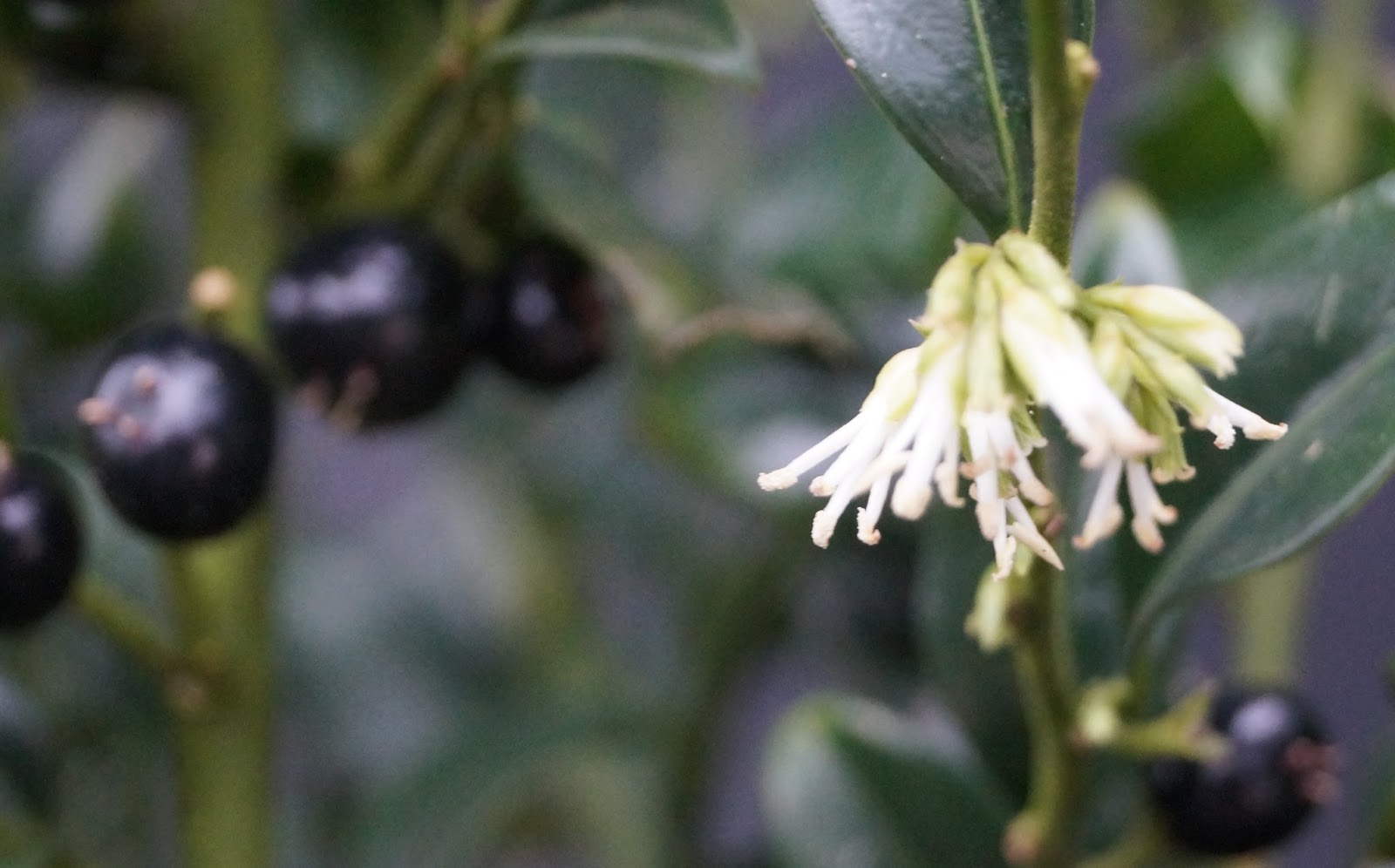
It is evergreen, so I use it in the shadier areas of the courtyard where I want to see year round colour. Even better, it is one of the least fussy shrubs I have ever grown. I neglected one in a shady corner of a woodland in my last garden for almost a decade and it showed absolutely no signs of stress. The natural cycle of the woodland should have kept it well-nourished, but even without nature’s help, this is a plant which will put up with a surprising amount of neglect.

Unlike the rest of the Sarcococca family, Sarcococca confusa doesn’t sucker. It will cope with pollution and tolerates dry shade wonderfully well, so it is one to consider for those tricky shady bits down the side of the house or shed. It can grow to 2m by 2m, but it does so very slowly and it isn't averse to being trimmed back. In fact, I intend to clip the groups of Sarcococca confusa in the courtyard in a similar way to Buxus sempervirens once they have reached a decent size, which may take a while, given their slow growing tendencies. If you want to clip Sarcococca confusa, do so in spring and give it a compost mulch - just because a plant will cope with neglect, doesn’t mean that we shouldn't give it a little help (this is my new year mantra and my garden is celebrating heartily).
 |
| Sarcococca and Buxus |
I love plants which hold flowers and fruit at the same time. Arbutus unedo is top notch for this and so is Sarcococca. Last year's berries persist and add interest during winter, when we really notice the plant. In other seasons, the shrub makes a quiet, evergreen and rather elegant addition to the garden while it gets on with the important business of suppressing weeds, forming structure and creating a backdrop for more showy planting.

Perfect for pots outside a shady front door, under trees, clipping into hedges, in an urban or rural setting, Sarcococca confusa makes a valuable addition to modern, slick borders as well as more traditional or natural planting. It will even cope with sun, so long as the soil is kept moist. Just because a plant is quiet and puts up with neglect, doesn’t mean that it isn’t treasured. I might forget about Sarcococca in the middle of June when brasher, showier flowers strut their stuff, but for the next three months I will be enjoying great nostril-loads of Sarcococca's beautiful fragrance and celebrating its quiet beauty every day.
Wishing you a happy, healthy new year.
I am joining with http://www.maydreamsgardens.com/ for Garden Bloggers' Bloom Day. Why not pop over there and see what else is blooming in gardens around the planet?
I am joining with http://www.maydreamsgardens.com/ for Garden Bloggers' Bloom Day. Why not pop over there and see what else is blooming in gardens around the planet?
Tuesday, 15 September 2015
If Bees and Butterflies Gardened
1980s fashion is making a comeback. Incredible though it might seem, one of my daughters has proudly claimed ownership of some of my old clothes!
30-year-old 501s no less, or should I say pre-loved vintage jeans? Suddenly I feel in tune with today’s teens, which is a welcome change, because usually I am at odds with them due to my lack of Kardashian general knowledge and a prehistoric preference for gardening blogs over make-up vlogs.
30-year-old 501s no less, or should I say pre-loved vintage jeans? Suddenly I feel in tune with today’s teens, which is a welcome change, because usually I am at odds with them due to my lack of Kardashian general knowledge and a prehistoric preference for gardening blogs over make-up vlogs.

Sometimes I find my tastes at odds with pollinators too. I may bill and coo over a spectacular bloom, but the pollinators might have other ideas, lavishing all their attention on a gentler, quieter flower. These plants are easy to overlook, especially if they bloom all summer and continue into autumn with little intervention from the gardener. One such long flowering perennial is Scabiosa columbaria subsp. ochroleuca. For the past fourteen weeks, bees and butterflies have been lavishing their attention upon its flowers. Fourteen weeks! And it will continue to flower its socks off well into October.

It is a dainty plant which prefers sun and well-drained soil. Masses of delicate primrose flowers are held aloft grey-green filigree foliage by wiry stems which sway gently in the summer breeze, yet shrug off autumn storms and torrential rain. It isn’t huge; it reaches just 50-60 cm tall (20-24"); and it may be quiet, but it is tough.

I left this scabious unwatered in dry weather this year and it thrived irrespective of my lack of care. I have a number of these plants in a demanding area of our garden: the carpark. It is unfenced, so deer and rabbits can come and go as they please. They cause damage to other plants, but they have never touched this scabious.

I grow it amidst a sea of Stipa tenuissima because the border gets buffeted by fairly lively wind. Since there is little point in fighting the weather, I have celebrated its excesses with grasses and scabious. Scabiosa columbaria subsp. ochroleuca is a pretty little thing. I love looking at it every time I park my car; yet it is the flurry of pollinators around the flowers which truly drew my attention to it and helped me to appreciate the huge contribution this quiet little plant makes to the garden. If bees and butterflies could garden, they would surely grow this plant.
I am linking with May Dream Gardens to celebrate Garden Bloggers' Bloom Day. Why not head over there and see what else is flowering today on this wonderfully diverse planet?
http://www.maydreamsgardens.com/
http://www.maydreamsgardens.com/
Thursday, 27 August 2015
The Archbishop of Canterbury and the Lambeth Palace Fig
Far be it from me to suggest that gardeners are an inquisitive bunch, but if we were to see a long, high wall which hid a garden from public view, would we turn down an opportunity to visit that garden? I know I wouldn't, especially if those garden gates had been closed to the public for 800 years. EIGHT HUNDRED! It feels as if I have been waiting every second of those 800 years to see this garden!

Lambeth Palace, home of the Archbishop of Canterbury, has the oldest continuously cultivated garden in London. Imagine! If you, like me, spent eternal terms at school colouring in booklets about Tudors, and then immersed yourself in televised Tudor shenanigans in later life, would you be able to contain yourself at the idea of wandering around Archbishop Thomas Cranmer’s patch? The very notion that this garden had already been in cultivation for 300 years in Henry VIII's time was almost enough to sidetrack me from the plants!

Of course, the garden is not as it was when Cranmer annulled Henry VIII’s marriage to Catherine of Aragon and married Henry to Anne Boleyn. Major changes took place after 1783, when John Moore became Archbishop. Walkways, tree belts and contouring made at his instigation can still be seen today. A fig tree, which was over 200 years old at the time, survived the changes. Ficus carica 'White Marseilles', was planted by Reginal Pole, the last Roman Catholic Archbishop of Canterbury, in 1556 (the year Cranmer was executed and just nine years after Henry VIII's death).


Archbishop Pole had been in exile for part of Henry VIII's reign, and it is thought that he brought the fig cutting to Lambeth Palace from Southern Italy. Last year, the Archbishop of Canterbury, Justin Welby, gave Pope Francis a cutting from the fig tree.

Nowadays the garden is maintained according to organic principles where possible. For the compostholics among us (which I hope is everybody), here is a photo of the engine room of the garden. Apart from the aforementioned wall, you can just about see the edge of the compost bays with their more advanced contents opposite these bins. I wouldn't normally excite us all with compost pictures, but then again, inspecting composting areas at palaces isn't an everyday occurrence for me.

At around ten acres, it is the second largest private garden in London (the garden at Buckingham Palace being bigger). It is located across the river from Parliament and right under the nose of St Thomas’ Hospital, so it is a busy place, yet it is surprisingly peaceful. Bee hives, flowers, lawns, trees, a swing, topiary, and a heron fishing in the pond. If it wasn't for the tops of double-decker buses and the Palace of Westminster peeping over the wall, we might be forgiven for thinking that we were in the countryside.

This private garden is used by the Archbishop, his family and staff. Despite its size, the layout makes it feel comfortable. It is one of those rare gardens that has a dimension which goes beyond design. It is not just all the layers of history; it is a special place to be.

The garden is only open to the public on two more occasions this year: the first Wednesdays in September and in October. If you happen to be in London on one of those Wednesday afternoons, I recommend that you grab the opportunity to visit; entry is just £4. It is next door to the Garden Museum, so it is very easy to combine a visit to the two.
Friday, 14 August 2015
New on the Menu for Bees in 2016 from Thompson & Morgan
When faced with a smörgåsbord of floral delights, which flowers are the favourites of our pollinating friends? This is something I constantly observe when visiting gardens and nurseries as it helps me to decide which plants will best broaden the nectar sources available in my own borders. I am always on the lookout for new plants, so I was delighted to visit Thompson & Morgan’s Open Garden at Jimmy’s Farm in Suffolk to take a look at some new introductions.
 |
| Thompson & Morgan's Open Garden at Jimmy's Farm |
Scabious are excellent bee plants and Scabiosa 'Kudos' is no exception. This new pink cultivar, described as virus free (presumably from cucumber mosaic virus, which can be a problem for scabious), looked delightful in a pot at the open garden, although I would gladly give this gorgeous plant plenty of border space.

2016 will be the Fleuroselect Year of the Cosmos and the party has started early at Thompson & Morgan's Open Garden. I posted photos of lovely pink Cosmos bipinnatus 'Cupcakes' last August and this year 'Cupcakes White' really grabbed my attention. I am clearly not the only fan of these beauties. Stocks of 'Cupcakes' sold out before the end of the spring sowing season this year and it is thought that only small quantities of seed will be released for the 2016 season, since bulking up stocks of new varieties takes time. If you are fortunate enough to grow this plant, it will be worth saving some seed for next year.

In this Cosmos celebration, Cosmos rubiata made an attractive and popular addition to the bee's buffet with its maroon blooms fading to pink, giving different shades of flowers on the same plant.

I am a fan of foxgloves, so I was interested to see Digitalis hybrida 'Polkadot Petra', which is a hybrid perennial foxglove from Thompson & Morgan's breeding program. It is a shrubby plant which flowers over a long period and I am told that it is more hardy than 'Illumination'.

I cannot remember having ever grown Zinnia. I have admired the flowers in other people's gardens for years, but was finally persuaded to add them to my seed list for 2016 when I saw Zinnia elegans 'Cupids Mix' strutting its stuff. This 50cm (20") tall plant was proving to be a spectacular bee magnet, and all for the price of a packet of seeds.

In the UK we have surprisingly few native plants. Happily, we are able to grow hybrids and a vast variety of plants from around the globe which offer food and shelter to wildlife. As I sit at my desk, looking out over a lavender border brimming with butterflies and bees, I cannot imagine being without non-native plants and hybrids. Of course I grow native plants, but I wouldn't want a garden where I couldn't try out new introductions and expand the nectar sources available to pollinators. I am always grateful to those who breed good garden plants, for their success breathes new life into my borders.
The Thompson and Morgan Open Garden may be found at: http://www.thompson-morgan.com/tmgarden
http://www.thompson-morgan.com/
http://jimmysfarm.com/
http://www.thompson-morgan.com/
Thursday, 9 April 2015
Gardening Sins and Penitent Pigeons
When I was five years old, I entered a name the doll competition at my school summer fair. I studied the list of potential names and rejected any I recognised in favour of one which my emerging reading skills were unable to decipher. It might not be the most scientific approach to competition winning (in my defence, the field of dolls' names guessing is notoriously under-researched), but it worked; and as I scrambled onstage to collect the doll with the name I couldn't read, I felt like the luckiest child alive.
 |
| Chaenomeles speciosa 'Nivalis' in the Barn Garden |
Maureen the doll travelled with me through childhood; a daily reminder that I had once been lucky. I haven’t won many prizes since then, but I do count myself as lucky, particularly when it comes to gardening. Garden luck comes in many guises; be it the weather, a happy chance seedling, or getting away with gardening misdemeanours. My gardening life has to fit around whatever else is going on at home and at work. Gardening calendars and years of horticultural training count for very little if the diary is filled with appointments with humans rather than plants. Worrying about a recurring failure to garden in a timely fashion is not going to help. Gardening should be fun and relaxing, not stressful. So I eat crops when they ripen and I try not to worry about tasks which will wait until tomorrow (or a week on Wednesday).
 |
| Aubretia living up to its reputation as a bee magnet |
 |
| Iris reticulata 'Blue Note' |
I often meet new gardeners who are frightened of putting a foot wrong with their plants. Fear seems to hold back their gardening potential and reduces their enjoyment of their plots. I have always believed that plants will survive if it is at all possible, irrespective of the level of care they receive from me. Of course they need to be planted correctly in a suitable soil and location, and their dietary needs should be met, but they can be remarkably forgiving when we garden a little less than perfectly.
 |
| Crocus tommasinianus forgave a very late planting |
Had there been an award for the most neglected fruit in England last year, my strawberries would surely have won first prize. Mulch was a distant memory, as were food and water. I didn't have high hopes of a single berry, but they proved me wrong. With luck like this, the pigeons will be sauntering past my cabbages, cooing, "We're sorry we ate your crops last year. Please don't hoe and net on our account, we've discovered the No Cabbage Diet and we only eat weeds. Oh yum... delicious dandelions.”

Actually, my good fortune in the strawberry patch left me feeling deflated. Had I tended those strawberries, I would have been delighted that the care I had lavished on them had resulted in a bountiful harvest. Since they cropped well irrespective of any effort on my part, the question of why we bother to garden raised its ugly head. I garden because I love gardening. I may rely too heavily on luck and I might not garden according to the timeframe I learnt in order to pass my exams, but I remain optimistic that the plants will forgive me and that one day I might achieve perfect timing with all my gardening tasks. As for the strawberries, even if they don't need it, they will be receiving abundant care this year. After all, my garden might manage perfectly well without me for a while, but I don’t believe in pushing my luck.
Subscribe to:
Posts (Atom)