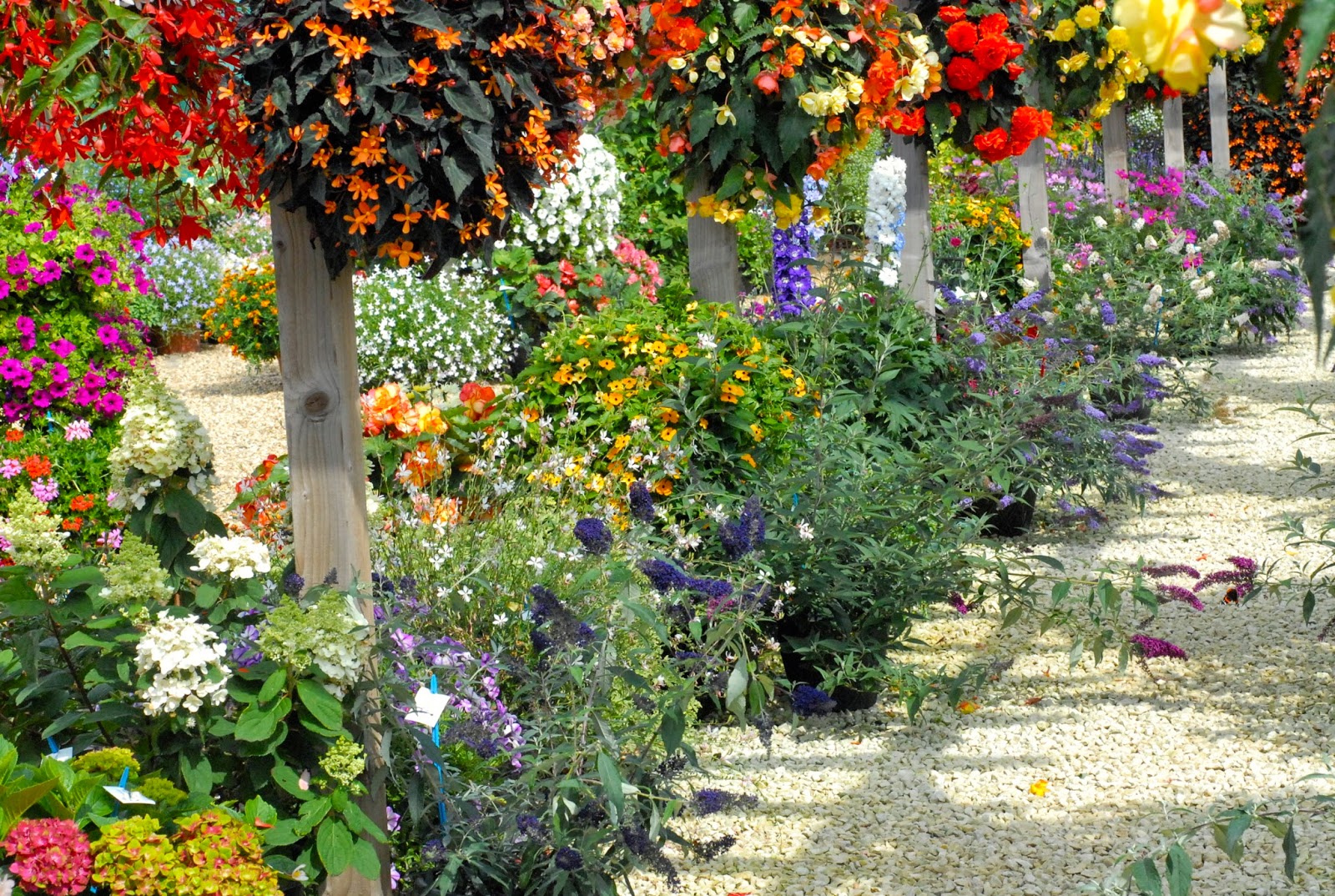
Showing posts with label Thompson and Morgan. Show all posts

Wednesday, 10 August 2016

Late Summer Colour in The Thompson & Morgan Garden

My beans are a disaster! Mountaineering slugs have been enjoying a beanfeast in the kitchen garden and I am left with two scrawny specimens climbing inconveniently up separate wigwams. Developments in plants can make a huge difference to our plots, and while I would love to find a slug-resistant bean (along with pigeon-proof brassicas and a self-watering pumpkin), I am always fascinated to meet any new cultivars and to see if their improvements match my gardening needs. Consequently, I was delighted to accept an invitation to see the 300-400 containers of plants being trialled in The Thompson & Morgan Garden at Jimmy’s Farm.
Fuchsia 'Princess Charlotte'
Sometimes we have no desire to grow a certain kind of plant. Perhaps it hasn't performed for us in the past, or it may never have had the opportunity to perform because it doesn't fulfil our requirements.
I have always regarded Gerbera as too tender for my plot and too fussy for the time I have available to pander to its needs, so to learn that Gerbera ‘Sweet Glow’ is hardy down to -10, flowers from early summer through to October and doesn’t mind being watered from above, means that it has made the rare leap from nowhere to the top of my wish list. There are also pink and yellow flowers available in the Sweet Series, but I particularly love the strength of ‘Sweet Glow’, which holds its colour well in bright sunlight.
Gerbera 'Sweet Glow'
I haven’t grown Amaranthus for years. We didn’t have a great falling out; it just dropped beneath the radar. Now it is firmly back on the must-have list thanks to the glorious great burgundy foliage of Amaranthus 'Molten Fire'. The leaves of this striking plant change to bronze as summer progresses and I can imagine it looking at home in mixed borders and exotic planting schemes.
Amaranthus 'Molten Fire'
It is decades since I planted any showy Salvia splendens, but Salvia 'Go Go Scarlet’ may be about to change that. It is certainly popular with bees, and unlike Salvia splendens, it doesn’t go to seed. 
Salvia 'Go Go Scarlet'
I loved Fuchsia as a child, and while I grow a couple of plants for berries in the kitchen garden, I have never embraced them ornamentally. Fuchsia 'Princess Charlotte’, with its compact form and upward facing flowers, is set to change this.
Fuchsia 'Princess Charlotte'
There were more surprises for me among Thompson & Morgan's new plants for 2017. I will write more about them in the autumn, by which time I might have recovered from the shock of finding myself drooling over a plant that I have never considered growing. Isn't it wonderful to be won over by plants?

Thank you to Thompson & Morgan for a very enjoyable, informative and eye-opening afternoon and for introducing me to the delights of the weeping peach, 'Lacrima'. Its succulent fruits have the good grace to hold themselves together so that the eater does not end up wearing bits of peach and juice dribbles down the chin in public.

If you are in Suffolk, do pop over and see Thompson and Morgan's show/trial garden. The plants are all clearly labelled and admission to the T&M garden is free. http://www.thompson-morgan.com/tmgarden

Friday, 14 August 2015

New on the Menu for Bees in 2016 from Thompson & Morgan

When faced with a smörgåsbord of floral delights, which flowers are the favourites of our pollinating friends? This is something I constantly observe when visiting gardens and nurseries as it helps me to decide which plants will best broaden the nectar sources available in my own borders. I am always on the lookout for new plants, so I was delighted to visit Thompson & Morgan’s Open Garden at Jimmy’s Farm in Suffolk to take a look at some new introductions.

Thompson & Morgan's Open Garden at Jimmy's Farm
Scabious are excellent bee plants and Scabiosa 'Kudos' is no exception. This new pink cultivar, described as virus free (presumably from cucumber mosaic virus, which can be a problem for scabious), looked delightful in a pot at the open garden, although I would gladly give this gorgeous plant plenty of border space.


2016 will be the Fleuroselect Year of the Cosmos and the party has started early at Thompson & Morgan's Open Garden. I posted photos of lovely pink Cosmos bipinnatus 'Cupcakes' last August and this year 'Cupcakes White' really grabbed my attention. I am clearly not the only fan of these beauties. Stocks of 'Cupcakes' sold out before the end of the spring sowing season this year and it is thought that only small quantities of seed will be released for the 2016 season, since bulking up stocks of new varieties takes time. If you are fortunate enough to grow this plant, it will be worth saving some seed for next year.


In this Cosmos celebration, Cosmos rubiata made an attractive and popular addition to the bee's buffet with its maroon blooms fading to pink, giving different shades of flowers on the same plant. 


I am a fan of foxgloves, so I was interested to see Digitalis hybrida 'Polkadot Petra', which is a hybrid perennial foxglove from Thompson & Morgan's breeding program. It is a shrubby plant which flowers over a long period and I am told that it is more hardy than 'Illumination'. 


I cannot remember having ever grown Zinnia. I have admired the flowers in other people's gardens for years, but was finally persuaded to add them to my seed list for 2016 when I saw Zinnia elegans 'Cupids Mix' strutting its stuff. This 50cm (20") tall plant was proving to be a spectacular bee magnet, and all for the price of a packet of seeds. 


In the UK we have surprisingly few native plants. Happily, we are able to grow hybrids and a vast variety of plants from around the globe which offer food and shelter to wildlife. As I sit at my desk, looking out over a lavender border brimming with butterflies and bees, I cannot imagine being without non-native plants and hybrids. Of course I grow native plants, but I wouldn't want a garden where I couldn't try out new introductions and expand the nectar sources available to pollinators. I am always grateful to those who breed good garden plants, for their success breathes new life into my borders. 


Thursday, 21 August 2014

Trial, Corruption and A Few Good Plants

Gardeners are an optimistic bunch. If a crop or plant doesn't succeed in one growing season, we reason that we can always try again next year. Eventually, after another year (or years if stubbornness and tenacity are combined with our natural gardeners' optimism), we might decide to move on and when we do there is usually something new, more vigorous, sweeter, higher yielding, more floriferous, taller or more compact to try, all thanks to the huge amount of work involved in breeding, selecting and trialling plants.  


I had the immense pleasure of touring the Thompson and Morgan trial site last week. The remnants of Hurricane Bertha had swept across this secret location the day before and threw hail and thunder at us while we were there, yet the Delphinium looked splendid. These glorious Delphinium are from Terry Dowdeswell in New Zealand and they are strong growing, blackspot resistant and have well-spaced flowers. 


The site is home to an extensive collection of plants being trialled in containers. These include shrubs such as Buddleja 'Buzz'™ and Hydrangea paniculata ‘Sundae Fraise’ which look great in pots. Needless to say, this is a popular spot with butterflies.


I love Limonium vulgare. We see it growing in the dunes on the beaches in Norfolk and I grow it in the farmhouse borders. The problem for me is that it is so insignificant in the garden setting that it is easy to overlook. Limonium ‘Blue Velvet’ has none of these shrinking violet tendencies. It is beefy without looking as if it is pumped up with steroids and although it is a good house plant, it looks wonderful outdoors. I sincerely hope it makes it through the trials as it has been catapulted to the top of my wish list. 


The container plants at the trial site are given a liquid feed every other day. At the other extreme, those growing in the field are watered when they are planted and then left very much to their own devices. The field, with its rows of crops and flowers battling with the elements is more akin to the growing conditions in my garden, so naturally I was keen to discover how the plants there fared. The truth is that not all of them are happy, which is just as it should be, otherwise how would we gauge any improvements?


I am particularly partial to pea tips, so I would normally look upon a pea trial as a potential grazing opportunity, but since most of the peas were mildew-ridden, I was saved the embarrassment of being caught eating the trial. I wouldn't have minded some of ‘Terrain’ though, it stood out like a beacon of health in a swamp of mildew. The contrast between the plants was astonishing. 


Strangely enough, an ornamental carrot really got me drooling. The frothy burgundy flowers of Daucus carota ‘Dara’ added that intriguing combination of darkness of colour and lightness in form to the border.  Although it is ornamental it produces a white edible root, but since it is a carrot, the flowers ought to be attractive to pollinators so despite my unseemly drooling, I won't be pulling up the roots for lunch.


A plant which is definitely great for pollinators is Ageratum. I have spent the past few years feeling guilty that I don’t grow it as I sow only larger annuals. Ageratum houstonianum ‘Timeless Mixed’ which is new for 2015, is a taller version which means that I will be re-introducing Ageratum to my garden next year. It also makes a good cut flower, which will doubtless continue the Ageratum cycle of guilt when I steal stems from the pollinators to pop in a vase. 


On a happier note, Cosmos bipinnatus ‘Cupcakes’ is simply beautiful. Even a cake-shy coeliac like me will want to see these cupcakes in the garden in 2016. It is just a pity we will have to wait for so long. 


In the meantime, there are always tomatoes. In a blind taste test of five varieties, ‘sweet aperitif’ came out tops for me. It will certainly be making an appearance on my seed wish list for 2015.


During the evening after the tour, it became apparent that my camera and computer were no longer happy to communicate with one another. My camera card was corrupt and my lap top was having none of it, so I was left pictureless. My thanks go to Thompson and Morgan for supplying the wonderful photos in this post. Thank you too to Michael Perry, Kris Collins and Hannah Ashwell for a fascinating tour coupled with timely cups of tea and the sweetest of pink blueberries to nibble on. 

If you want to know more about Thompson and Morgan, they are at:
http://www.thompson-morgan.com/

If you want to read more about the day:

http://www.blackberrygarden.co.uk/2014/08/a-visit-to-thompson-and-morgan-trial.html
http://blog.plantpassion.co.uk/2014/08/great-new-cut-flower-varieties-at-the-thompson-and-morgan-trials-field.html
http://gardenerinnit.wordpress.com/2014/08/18/my-first-attempt-at-this-blogging-malarkey/
http://hoehoegrow.blogspot.co.uk/
http://vegplotting.blogspot.co.uk/


Tuesday, 1 April 2014

The Post About a Post Post

Gardeners like to experiment in their gardens, so if a gardener stumbles into the blogosphere, it stands to reason that before long the blogging gardener will start to experiment there too. 


My attempt at a blogging gardener's experiment is to try guest blogging and I have just had a guest post published at the Thompson & Morgan blog about one of my favourite high value, low cost plants. http://blog.thompson-morgan.com/your-stories/high-value-low-cost-plants-cerinthe-major-purpurascens/

I wasn't paid to do it, or even offered a packet of seeds. I just wanted to tell people about this amazing plant. I know it's a cheek, but I would be ever so grateful if you would be kind enough to click on the link and make a comment so I don't look completely like Sarah-No-Mates. Thank you! I will be back here tomorrow celebrating the best thing about spring.