Showing posts with label Wildlife. Show all posts

Friday, 25 May 2018

Is Chelsea a Flower Show?

I may be about to commit horticultural heresy. The exhibitors at Chelsea Flower Show have wowed us with blooms grown to perfection and colour combinations to die for. We have fallen in love all over again with lupins, and drooled over myriad pinks, roses and delphiniums, but for me, once I have had my fill of beautiful flowers, the little bit of Chelsea I take home and try to apply to my own patch involves the quiet, unsung hero of flower shows: foliage. 
Flowers in Janine Crimmins' Very English Garden
Yes, I know the clue is in the name. It’s not called Chelsea Flower Show for nothing, but I wish that it could be the Chelsea Plant Show because the use of foliage is top-class. I also think that the exquisite hard landscaping should get a shout-out, as alluded to in Andrew O’Brien's excellent Gardens, Weeds and Words*, but the Chelsea Plant and Hard Landscaping Show hardly rolls off the tongue.
Chris Beardshaw's garden for NSPCC

The first-rate use of foliage in Tom Stuart-Smith's celebration of 60 years of The Weston Garden and Robert Barker’s Skin Deep Garden will live long in my memories of Chelsea 2018. Good foliage, well combined, is a feast for the eyes (and admittedly, caterpillars, rabbits, and deer, but let us not forget that flowers have their troubles too). Of course, everything is as perfect as it can be at a show. I have yet to see a hungry bunny or a ravenous deer at Chelsea, let alone a gluttonous sawfly.
Tom Stuart-Smith's Weston Garden
Leaves are workhorses. They are photosynthesis powerhouses that retire from their working lives by falling from the plant and removing waste, before rotting down to produce precious leafmould. In short, they are excretophores, which doesn't sound terribly glamorous, but leaves are capable of doing it with such panache. After all, people travel miles to admire pre-waste-disposal autumn
leaf colour. 
Robert Barker's Skin Deep Garden

Long after we’ve finished swooning over fleeting peonies, foliage will still be quietly doing its job and earning its keep in our borders. Thoughtful foliage planting can create a beautiful textural tapestry. Combine it with striking bark, and you have the recipe for a heavenly display that will continue long after the flowers have finished showing off.
Robert Barker
It might seem strange for someone besotted with wildlife to focus on foliage at a flower show instead of pollinator-friendly blooms, but where would the flowers be without  leaves? Beautifully mingling foliage combinations linger longer than purely floral planting. Leaves help to rest the eye and make an excellent foil for showier plants, all while providing valuable ground cover for wildlife and helping to suppress weeds.
Tom Stuart-Smith

Designing with foliage is not just for the ornamental garden. Creative planting may be used in the vegetable patch to great effect. Just think of the combination of corn, beans and squash in Three Sisters planting, or take a look at Mark Gregory's Welcome to Yorkshire garden at Chelsea. Why shouldn’t vegetables feed the eye as well as the belly?  
The Chelsea Flower Show is a place for perfection and dreams. While those at the Saturday sell-off may find themselves sharing a tube carriage with ramrod straight delphiniums, the rest of us leave with more portable souvenirs. In my case, it is a camera filled with inspiring foliage combinations. While foliage 
might not steal the show, its impact is huge. Chelsea is so much more than just a flower show.

*http://www.gardensweedsandwords.com/gwwblog/rhs-chelsea-flower-show-2018-1

Tuesday, 14 February 2017

Planting for Wildlife

I recently saw a post on social media from a gardener who was worried about overwintering her Pyracantha cuttings. While many replies were supportive, they were littered with calls for the gardener to destroy her plants. My hackles were raised. Pyracantha is hugely valuable to wildlife. Fancying myself as a knight on a charger, I thundered to fair Pyracantha’s defence (only I’m a gardener at a laptop and I’m a little bit scared of thunder). 
My thoughts have been published on the fabulous Guardian Gardening Blog. I know it’s a big cheek, but I would be ever so grateful if you might take the time to pop over there and comment please so that I don’t look like a complete Sarah No-Mates. The link is below. Thank you. 

https://www.theguardian.com/lifeandstyle/gardening-blog/2017/feb/14/in-praise-of-pyracantha

I'll be back here soon with gorgeous February flowers for bees.

Tuesday, 3 January 2017

Garden Blogs and Good Intentions

I am one of those gardeners for whom the new year is like a starting gate catapulting open in a horse race. Waking up on January 1st is the point at which the door is released and the prize-winning filly hurtles towards the finishing line, only in my case I'm a mare running like the clappers towards the seed catalogues, and there is nothing prize-winning about me (my track record with raffle tickets speaks for itself).

I had planned to focus solely on ornamental seeds during early January, but my head has already been turned by edibles. Pipiche is an attractive Mexican herb, so it might be considered ornamental, but Carosello looks like a hairy cucumber. Had I resolved to exercise more self-control, I would have failed in my resolution on day one. Thankfully, the older I get, the more resolved I become to never make a resolution, which is a resolution in itself. It only goes to show how unsuccessful resolutions can be.
When I started blogging I had no clear idea of what I was trying to achieve. I knew that I wanted to share the joy of gardening with nature in mind. All of the photos in this post were taken over the festive period. Had I cut back and tidied the plants in autumn instead of leaving them to provide food and shelter for our wilder friends, imagine how flat and dull my garden would have been. I might not win any raffles, but the wildlife and the sight of the plants on a frosty morn makes me feel like a winner.
It took a few months for me to pluck up the courage to publish my first post. I chose the easiest platform I could find and didn’t commit myself to a domain name. I had read blogs for some time and I really loved the blogosphere. I still do. Being part of this global community has taught me to be a better gardener. Now I want to learn to be a better blogger, so I am starting the year by asking for your advice.
If I were to change the blogging platform, are there pitfalls I should watch out for? Would adding a culinary section to the mix be a good idea? What about historical posts and comments - do they travel well? Have you ever changed the name of your blog? If so, was that an issue? What works and what doesn't about this blog? You may quite rightly be concluding that I have as much of a clue about what I’m doing as I have about growing that hairy cucumber lookalike, Carosello. Of course, if you have any advice on growing Carosello, it will be more than gratefully received.
Perhaps I should leave The Gardening Shoe well alone and go and focus on something more predictable, like selecting veggies to grow in 2017. The most predictable aspect of which will be the addition of a couple of ornamentals to the edible list. After all, there is bound to be something I forgot to order while I was getting sidetracked by Carosello and Pipiche. Such is the nature of seed catalogues and good intentions. 

Thank you for all your encouragement and support over the years. Wishing you health and happiness in 2017. I look forward to reading your blogs and salivating over your beautiful photos this year. Here's to you!


Wednesday, 4 May 2016

The Garden Nursery

When I was six years old, I loved to tiptoe quietly into the garage to peek at the silhouettes of baby blue tits in the bird box my dad had built into our garage wall. The back of the box was glazed and covered with brown paper which gave the birds a sense of privacy while allowing us the opportunity to see something of their lives. My dad died the following spring, but the seeds of my fascination with the natural world were already sown.

Nowadays we don’t need to head into the garage to see silhouettes of chicks in a nest. For Christmas I received a bird box with a camera in it. I suspect that the gift is part of a cunning plan to encourage domesticity as the nesting box is sited directly opposite the kitchen window under which there is a sink. Since the sink is required to fill the kettle, the domesticity plan has backfired to the point that far from motivating me to attempt kitchen chores, there has been a significant increase in the quantity of time I spend sitting down. I have always drunk coffee on the hoof, but if there is any activity around the bird box while I am filling the kettle, I fire the remote at the television, plonk myself into a chair and ogle the nest while enjoying a lovely warm drink and wondering what Dad would have thought of this wireless camera bird box. 
The nest taking shape
The most astonishing accomplishment of this piece of technology is that it has caught the attention of my own offspring. Instead of the usual fare they enjoy on television, they have been spotted watching nature. Out of choice! Surely this is a healthy form of screen time?
Feathering the nest
From the comfort of the kitchen we have also been watching over a mother who hatched 11 ducklings. The nest is in the lavender which I have yet to cut back after flowering last year. I don’t cut back plants until spring because of the shelter they offer to minibeasts. I hadn't considered that the same plants might offer shelter to much larger creatures. Of course, my lavender tends to fall apart more quickly than it would had I shorn it after flowering, but it is easy to strike cuttings so I always have a ready supply. The courtyard where the ducklings hatched is a former boar pen. In the two years since it was converted into a garden, 22 ducklings have made their way into the world under the cover of the plants.
The garden feels like a dating disco. Our feathered friends are busily pairing off and doing the bird equivalent of The Birdie Song while dancing around their handbags, or in the case of Mr & Mrs Pheasant, tiptoeing through the tulips, (aptly named Tulipa 'Night Club'). At this rate - and with any luck - we will be inundated with offspring!
Mrs P doesn't look impressed. 
Perhaps she doesn't like the tulips.
There is a baby boom in my office too. Since I don't have a greenhouse, the office floor must double up as a nursery. Butternuts, tomatoes, peppers and Cosmos are jostling for light and waiting impatiently to fledge. It is hardly the ideal start for a plant, but they are safer indoors than in the cold frames where they would become frazzled with frost in no time. I rather like sharing my office with them; I only wish that the greenfly hadn't followed them in. The office greenfly are clearly very happy with the food and shelter on offer as they are procreating like it is going out of fashion. One solution will be to bring in the ladybirds. This is all putting a most unlikely slant on the notion of a busy day at the office. 

I am joining with Wildlife Wednesday at https://mygardenersays.com/ Why not pop over there, grab a drink and spend some time marvelling at the wildlife in gardens around the globe?


Wednesday, 2 December 2015

Sowing Seeds for Wildlife and the Trouble with Hummingbirds

Seed catalogues should come with a health warning for wallets. A packet of seeds costs very little, but how often do we disappear into the magical world of glossy plant photos and find ourselves in a parallel universe where we have endless time to garden and limitless growing space? Even if our gardening lives were perfect, we would probably still be faced with a space/time dilemma if every flower, fruit and vegetable we desired leapt from the page and onto the credit card. Consequently, this time of year, which is normally associated with excess in the eating and drinking department, is a time for exercising restraint as a gardener. I am not fond of exercising - be it in a gym or restraint on the plant front - so as a reward for my sporadic gym attendance, I allow myself a little light indulgence in the form of two packets of I've-never-tried-these-before seeds per year.


Seeds purchased in one year cannot qualify as newbies the following year, so if they are any good, they are automatically transferred to the regular seed purchase list, thereby allowing space for two more packets of newbies. A problem arises if all the newbies turn out to be goodies. A decade of two successful new must-haves annually equates to twenty new seed packets in ten years (my maths genius knows no bounds). Add these seeds to those which have become essentials over the previous years of your gardening life and you have a whole load of seed packets (I am not even going to risk guessing your age, but please feel free to do your own calculation). 


Pollinator magnet Eschscholzia californica
Of course, if a plant is a consummate self-seeder, all is good and well. We buy it once and enjoy it forever. Cerinthe major falls into this category and if you have never grown it, I really recommend that you add it to your wishlist if your conditions suit. I posted about it here http://blog.thompson-morgan.com/high-value-low-cost-plants-cerinthe-major-purpurascens

Pollinator magnet Cerinthe major 'Purpurascens'
A plant which has seeded itself into the buy-once-enjoy-forever category in recent years is pollinator magnet extraordinaire, Echium vulgare ‘Blue Bedder’. Bright blue flowers emerge from pink buds and turn magenta as they fade. These breathtakingly beautiful flowers adorn bristly stems from June until at least October (by at least, I mean that they are still in flower in December this year). 


Pollinator magnet Echium vulgare 'Blue Bedder'
A dry, sunny spot suits 'Blue Bedder' perfectly. It copes near the coast, looks wonderful in a cottage garden style planting and is happy in a container. It is at home mingling with grasses and contrasts well with the soft foliage and sulphur yellow flowers of Alchemilla mollis. Sow it indoors in February and March or direct from March to May, after which, hopefully, you will not have to buy it again. It self-seeds in my garden, but not so much that I have to compost excess plants.


Echium vulgare - or viper's bugloss - is classed as a noxious weed in certain areas of the world. Here in the UK some farmers don’t like it as it can seed into fields where it puts its roots down deeply. ‘Blue Bedder’ is an annual viper's bugloss which at 45cm, is more compact and bushy than the viper's bugloss we see growing in gravel pits and along roadsides. It is hugely attractive to bees, butterflies and moths and I have read that it is a hummingbird magnet. If only we had hummingbirds in the UK... not that you would see a great photo of one if we did. I have an extensive collection of photographs of plants which a hummingbird has just left. The best I have ever managed is this. Look closely, it is there, although it might very well be a sparrow for all the detail you can see. Pitiful, isn’t it?


I am linking this post to Wildlife Wednesday which is hosted by Tina at http://mygardenersays.com/ . Do please take a trip over there to marvel at the wonderful wildlife in gardens around the planet. I guarantee that this hummingbird photo will be the worst one you will see in the whole meme *hangs head in shame.

Wednesday, 4 November 2015

Evolving Gardeners

Anyone who has ever caught a tube train in London will know that even if there is barely a square inch of floor showing in a carriage, some twinkle-toed commuter will pop their feet onto it and we will all squeeze a little closer to accommodate those parts of their body which are broader than their little toe, because there is no such thing as a full tube train. In much the same way, there is no such thing as a full garden border. The plant lover will always find room to squeeze in one more must-have plant which has leapt unbidden into the shopping trolley. I have the same problem with books. Thankfully, the introduction of e-readers has alleviated the shelf space issues caused by my fiction habit, but when it comes to gardening books, I am old-school.


The trouble with gardening books, lovely though they are, is that gardening advice changes over time. Crocks in pots are now a thing of the past; tree planting holes have changed shape; and what was once a weed might now have developed into a deeply desired wildflower. One of the most significant changes in my lifetime is the way in which we put a garden to bed for winter. Once upon a time, I might have left leaves and stems only on borderline hardy plants as a means of protection during the colder months; now I leave the stems on all of the perennials. The closest I get to an autumn tidy is harvesting the leaves off lawns and paths for my favourite crop from the garden (at least, until I work out how to grow chocolate bars) - leafmould. 

Teasel
For me, cutting back plant stems at this time of year is an opportunity lost. I care about the wildlife in my garden. Offering protection in the form of these stems is not a hardship for me, but it could mean the world to seed-eating birds or to minibeasts and (sadly for the little critters) those creatures further up the food chain who feed upon them. Before I took the decision to garden with wildlife in mind, I had started to leave a few seedheads in place, simply for the pleasure of their company over winter and to see them donning their frosty hats on a cold January morn. 

Echinops
My favourite task in the garden is cutting back spent flower stems in spring. I don’t compost them immediately; I leave them stacked neatly for a few days to give any wildlife the opportunity to move on. In spring, plants may be already coming back into growth; certainly there is barely any time to wait until fresh foliage emerges and bulbs begin to bloom. I find cutting back in autumn depressing as the tidied-up plants will not be back in growth until next year. Cutting back in spring is exhilarating because we can see something new emerging; we have something to look forward to!

Cutting back in Spring
If you are thinking about cutting back your perennials now, why not try resisting the urge? Hang up the secateurs and do something filled with hope for a new season, like planting bulbs or sowing seeds. I understand that tidy gardeners might struggle with the idea of not cutting back, but placed in the right spot, perhaps with repetition further along the border, seedheads are structurally interesting and can make pleasing design sense. You never know, if you take a chance and leave the stems, a new seedhead design opportunity might present itself. When you cut back the plants in spring, you can seize the moment to divide, replant and create your new scheme. Then you will be able to enjoy the fruits of your labours through summer, autumn and winter, while at the same time offering shelter to minibeasts; and it won't have cost you a penny.


I am linking this post with Wildlife Wednesday at http://mygardenersays.com  Why not pour yourself a drink and saunter over there to see some fabulous photos of the diverse wildlife to be found in gardens around our beautiful planet?

Wednesday, 7 October 2015

Gardening for Wildlife in a Courtyard

Sometimes a place looks as inhospitable to wildlife as it is possible to be. When I started work on converting a boar pen into a courtyard last year, there was little to recommend it to our wilder friends. 

You can just see our front door on the right. Welcoming, isn't it?
The 17th century threshing barn which formed one wall to the boar pen was converted into our home, and the farmyard is in the process of becoming a garden. A biodiversity survey undertaken prior to the build concluded rather damningly that "this barn site proved to have quite a low Biodiversity presence and potential". I immediately decided that I would garden with wildlife in mind to see if it could make a difference.

Looking down from the barn to the courtyard. The doors lead
 to piggeries (now rooms)
I did wonder if a courtyard was capable of attracting much wildlife. This area is treated like part of our house as there are rooms around it which all require access. Paving is a necessity here, but it didn't all need to be paved so some concrete was removed to create borders.  

                  Spring 2015
Having barrowed in a load of topsoil, I popped in plants which would be particularly attractive to pollinators; and guess what? The plants did their job. Walking along the garden path is a joy because of all the butterflies and bees. 


I might have selected plants for pollinators, but other wild friends had their own ideas. Acanthus mollis proved to have broad wildlife credentials. A magnet for pollinators in summer and a hiding place for minibeasts in autumn (I don't cut back the flower stems as they make superb bug hotels), it also provided valuable cover for this young lady who hatched 11 ducklings under its lush foliage.


The courtyard now has a rather splendid resident newt and we are being visited by an increasing number of birds, including a cheeky pied wagtail which frequently perches on my office door handle. 


This is a very new garden. I still haven't finished planting it, yet it is already attracting a range of creatures. The farmyard might once have had quite a low biodiversity presence, but even the most unlikely places can become a haven for wildlife.

Lavandula x intermedia 'Sussex' in the courtyard

I am linking this post to Wildlife Wednesday at http://mygardenersays.com/ Why not pop over there to see some beautiful photos of wildlife in gardens elsewhere on our wonderfully diverse planet? 

Tuesday, 15 September 2015

If Bees and Butterflies Gardened

1980s fashion is making a comeback. Incredible though it might seem, one of my daughters has proudly claimed ownership of some of my old clothes! 
30-year-old 501s no less, or should I say pre-loved vintage jeans? Suddenly I feel in tune with today’s teens, which is a welcome change, because usually I am at odds with them due to my lack of Kardashian general knowledge and a prehistoric preference for gardening blogs over make-up vlogs.


Sometimes I find my tastes at odds with pollinators too. I may bill and coo over a spectacular bloom, but the pollinators might have other ideas, lavishing all their attention on a gentler, quieter flower. These plants are easy to overlook, especially if they bloom all summer and continue into autumn with little intervention from the gardener. One such long flowering perennial is Scabiosa columbaria subsp. ochroleuca. For the past fourteen weeks, bees and butterflies have been lavishing their attention upon its flowers. Fourteen weeks! And it will continue to flower its socks off well into October.


It is a dainty plant which prefers sun and well-drained soil. Masses of delicate primrose flowers are held aloft grey-green filigree foliage by wiry stems which sway gently in the summer breeze, yet shrug off autumn storms and torrential rain. It isn’t huge; it reaches just 50-60 cm tall (20-24"); and it may be quiet, but it is tough.


I left this scabious unwatered in dry weather this year and it thrived irrespective of my lack of care. I have a number of these plants in a demanding area of our garden: the carpark. It is unfenced, so deer and rabbits can come and go as they please. They cause damage to other plants, but they have never touched this scabious.


I grow it amidst a sea of Stipa tenuissima because the border gets buffeted by fairly lively wind. Since there is little point in fighting the weather, I have celebrated its excesses with grasses and scabious. Scabiosa columbaria subsp. ochroleuca is a pretty little thing. I love looking at it every time I park my car; yet it is the flurry of pollinators around the flowers which truly drew my attention to it and helped me to appreciate the huge contribution this quiet little plant makes to the garden. If bees and butterflies could garden, they would surely grow this plant. 

I am linking with May Dream Gardens to celebrate Garden Bloggers' Bloom Day. Why not head over there and see what else is flowering today on this wonderfully diverse planet? 
http://www.maydreamsgardens.com/

Tuesday, 28 July 2015

Making a Garden for Wildlife

I was wielding the hoe through a recently planted border (AKA weed seed magnet), cursing taproots and apologising to dormant tulip bulbs wrenched from their summer slumbers by my frenzied hoe-flailing, when a lady stopped by and asked if I might give a short talk to the local gardening club about the development of the gardens at Le Grys Farm. Uncertain as to whether she had heard me begging the bulbs' forgiveness, but fairly certain that her sudden appearance had caused me to yelp in surprise (I imagine the bulbs probably did likewise when they were dragged from the soil moments earlier, if indeed bulbs yelp), I agreed to speak and immediately set about wondering what on earth this lady thought I might have to say.


The Farmhouse Garden
I have blogged in the past about gardeners’ minds being fixed in the future* and as I watched the lady leave, I realised that I had been so busy planning the next area of garden that there had been no time to appreciate the more established borders. Thanks to that lady, I found the time to look at the garden and to reminisce on what was originally here.

The dining room in 2000
When we bought Le Grys Farm in 2000, the 16th century Farmhouse had been empty for 20 years. There was electricity in just one or two rooms and there were no bathrooms, which was marginally inconvenient as I was pregnant with twins and the nearest public loo was 2 miles away. There was a Wisteria, which I can only describe as pollarded to within an inch of its life. Obviously this did little to aid the bathroom issue, but it did fill me with hope that we might one day have a garden. The only other plant in the garden was a walnut tree which was too young to fruit. I left the walnut to continue its childhood, put up wires for the Wisteria and set it free (in as much as anything trained along a wire is ever free), then I planted Old English lavender across the front of the house, had the lawn seeded and a gravel drive put in. That's it. We didn't live here and everything had to be very easily maintained in our absence. 

The Farmhouse Garden 2012
Over a decade flew by before we were able to move to Norfolk. Clearly a garden comprising a walnut, a Wisteria and a lavender hedge is hardly going to satisfy a gardener's desire to grow things, so I set about creating the first of a number of gardens here. The walnut was finally getting its act together on the fruiting front, so I sited the garden paths around it. I propagated and purchased plants to add to those I brought with me: Geum rivale which had been dug from my aunt’s garden and had flourished in two of my gardens since; and Salvia uliginosa, which I bought at a plant fair and hung from the back of my baby daughter’s pushchair. That daughter is now 12 years old, and The Farmhouse Garden is three. 

The Farmhouse Garden 2012
When we purchased the farm, there was an agreement with the vendor that he would have use of the farmyard and some buildings until 2010. In actual fact, they were used by him for a couple more years. By then, an ecological survey had revealed that there was a low biodiversity presence in the farmyard. I decided that this had to change. Starting with my plant selections for The Farmhouse Garden, I would garden with wildlife in mind.

The Farmhouse Garden 2014
Apart from providing shelter and sustenance for wildlife, The Farmhouse Garden has to be easily maintained within four hours a week, for it is a space to be enjoyed by holiday makers. Quite rightly, guests at The Farmhouse want their family pet to have a holiday too, so dogs are welcome. The lawn becomes a space for ball games, bouncy castles and barbecues so I cannot afford to be too precious about its state, or that of the plants. Toddlers will toddle through borders; dogs have a knack of leaving the path, so plants must be resilient to the rigours of family life. They must also benefit wildlife, be beautiful for the guests to enjoy, and not cost the earth to replace.

The Farmhouse Garden 2015
Propagating and shopping for plants is always a pleasure. Making a garden is a privilege; sharing that garden with guests and wildlife is a joy. Three years after beginning the first of the gardens here, the days of wondering where the wildlife is are well and truly over. There are pollinators and birds aplenty. We share our gardens with bats, owls, newts and ducks; and thanks to extensive fencing, we see, but are rarely troubled by rabbits, hares and deer. We still have a long way to go in making our gardens here, but now that I have taken the time to look at The Farmhouse Garden, I am surprised to see that we have already come a long way. 

*http://thegardeningshoe.blogspot.co.uk/2013/09/f-hybrid-gardening-contortionists.html

Tuesday, 10 September 2013

The Great Escape.... Gardener Style

Is it any wonder that gardeners love visiting gardens? Other people’s plots provide us with inspiration, confidence boosters, tea, cake and shopping opportunities. We return home fizzing with ideas and cradling the must-have plants which leap into the trolley we unwittingly drag behind us whenever we enter a plant sales area.

The Exotic Garden at East Ruston Old Vicarage
We all have our favourite kind of garden. I particularly enjoy newer gardens because I like to return and see them as they mature. I have visited the garden at East Ruston Old Vicarage over many years and have delighted in watching it develop. On a recent tour I was intrigued to spot a patch of bare soil and an array of splendidly funky obelisks. A plot under construction is the gardening equivalent of a cliffhanger and one thing is certain: I will be back to see how these borders come along. 


There are exciting developments at Holkham Hall too, where the 6.5 acre walled garden is being renovated. This year, gardeners and volunteers have planted in the region of 5,500 plants which are already attracting plenty of pollinators. Holkham Walled Garden has a blog*, so even if you are unable to visit, do follow the progress of this ambitious project. 

Arena of Plants, Holkham Hall
Piet Oudolf's Millennium Garden at Pensthorpe underwent extensive work in 2009 to re-establish two-thirds of the garden and look at it now!


Arranged in large groups  - don't think threes; think thirty-somethings - this is high-impact planting for humans and wildlife alike. It is not the only garden at Pensthorpe;  Julie Toll's Wave Garden is a serene and tranquil space and the Wildlife Habitat Garden is a lesson in providing for the needs of butterflies, bees, dragonflies, damselflies, amphibians, reptiles, beetles and bats. 


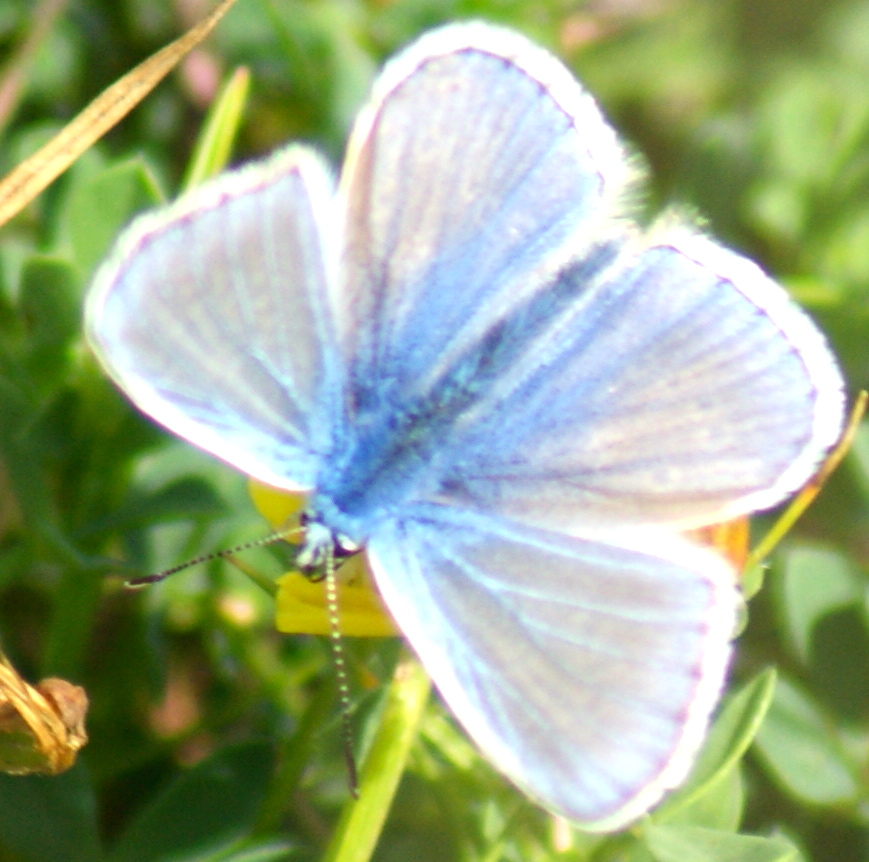
Common Blue Butterfly at Pensthorpe
There is something reassuring about seeing other gardeners gardening. When I visited East Ruston, Alan Gray was planting Sedum; at Holkham, volunteers were weeding; and at Pensthorpe, there was a gardener toiling in the Millennium Garden. To non-gardeners, the concept of a gardener taking a day out to a garden to watch a gardener garden might sound a bit like a cross between a busman's holiday and a bad tongue twister, but we return from these gardeners' getaways raring to tackle the weeds, or tweak a planting scheme and create space for the plants which slipped so cheekily into our shopping trolleys. 


 One-year-old border in our Farmhouse Garden 
We have a lot of landscaping work ahead of us at the farm and since this is our soon-to-be courtyard garden (I hope your imagination is firing on all cylinders), I am going to be in serious need of inspiration, confidence boosters, tea, cake and shopping opportunities.


Perhaps it's time for another day out.

http://holkhamwalledgarden.blogspot.co.uk/2013/05/the-arena-of-plants-arena-of-plants.html?utm_source=BP_recent
http://www.pensthorpe.com
http://www.e-ruston-oldvicaragegardens.co.uk