Showing posts with label Wisteria. Show all posts

Sunday, 19 March 2017

Fruit Blossom, Seed Sowing and the Joys of Spring

Fresh green leaves are unfurling on the gooseberries and mirabelles. The pluot has burst into flower and I am screaming "No! Not Yet! Get a grip on yourselves and wait a while!"
Pluot
I might be filled with the joys of spring were it not for an all-pervading fear that Jack Frost will sneak into the garden and teach these precocious blooms a lesson or two in timing. 
Pyrus calleryana 'Chanticleer'
If, like me, you garden without a greenhouse in the UK, you are probably exercising more patience than you ever thought possible. Every year I exceed my own expectations in the self-control department and with gargantuan effort, I usually manage to put off sowing vegetable seeds until late March. Even so, my office window has already disappeared from view thanks to a handful of ornamentals.
The table I use for seedlings has been backed by reflective foil and moved to a window. It is ready for action, and where am I? Still in the throes of bare root hedge planting. Meanwhile the weeds are having a field day hurling their seeds willy-nilly and the Wisteria is strangling a drainpipe. All of this activity means that while half of me is hoping that temperatures will not plummet, particularly as I am excited to try my first homegrown pluot, the other half is wishing that winter could last another week or three to give me a chance to catch up with long overdue gardening tasks. 
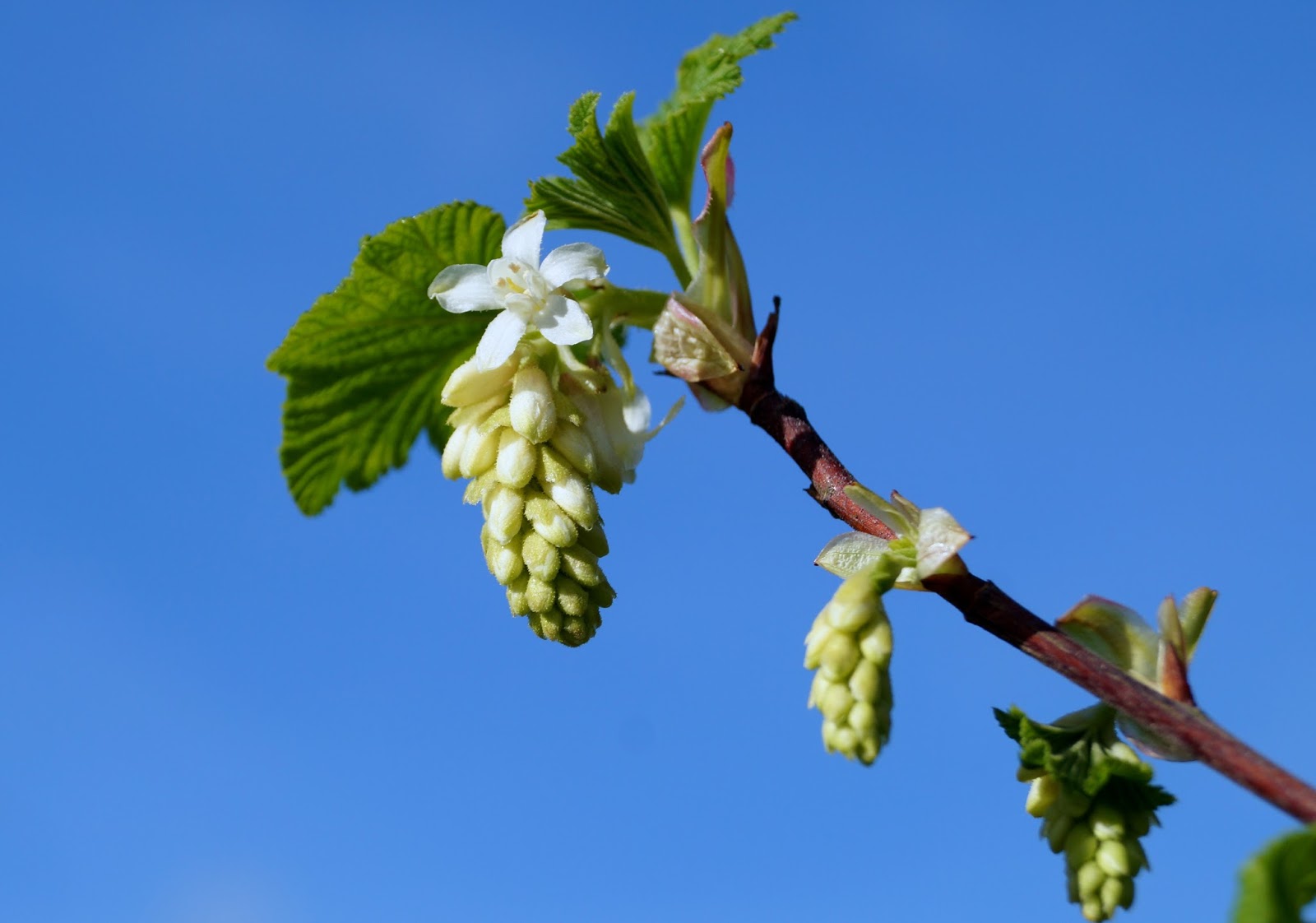
Unfurling Ribes
The answer, of course, lies in a cloak of fleece for the pluot to snuggle under should the weather turn, and for me to tackle the weeds and Wisteria. The fleece is a must, but if spring turns wintry, I shall be holed up in the potting shed with my seed collection and, joy of joys, a packet of pristine plastic plant labels. After all, it would be folly to climb a ladder to deal with a wayward Wisteria in bad weather, and as for the weeds, well, they can wait. They are, after all, a never-ending task.

Tuesday, 28 July 2015

Making a Garden for Wildlife

I was wielding the hoe through a recently planted border (AKA weed seed magnet), cursing taproots and apologising to dormant tulip bulbs wrenched from their summer slumbers by my frenzied hoe-flailing, when a lady stopped by and asked if I might give a short talk to the local gardening club about the development of the gardens at Le Grys Farm. Uncertain as to whether she had heard me begging the bulbs' forgiveness, but fairly certain that her sudden appearance had caused me to yelp in surprise (I imagine the bulbs probably did likewise when they were dragged from the soil moments earlier, if indeed bulbs yelp), I agreed to speak and immediately set about wondering what on earth this lady thought I might have to say.


The Farmhouse Garden
I have blogged in the past about gardeners’ minds being fixed in the future* and as I watched the lady leave, I realised that I had been so busy planning the next area of garden that there had been no time to appreciate the more established borders. Thanks to that lady, I found the time to look at the garden and to reminisce on what was originally here.

The dining room in 2000
When we bought Le Grys Farm in 2000, the 16th century Farmhouse had been empty for 20 years. There was electricity in just one or two rooms and there were no bathrooms, which was marginally inconvenient as I was pregnant with twins and the nearest public loo was 2 miles away. There was a Wisteria, which I can only describe as pollarded to within an inch of its life. Obviously this did little to aid the bathroom issue, but it did fill me with hope that we might one day have a garden. The only other plant in the garden was a walnut tree which was too young to fruit. I left the walnut to continue its childhood, put up wires for the Wisteria and set it free (in as much as anything trained along a wire is ever free), then I planted Old English lavender across the front of the house, had the lawn seeded and a gravel drive put in. That's it. We didn't live here and everything had to be very easily maintained in our absence. 

The Farmhouse Garden 2012
Over a decade flew by before we were able to move to Norfolk. Clearly a garden comprising a walnut, a Wisteria and a lavender hedge is hardly going to satisfy a gardener's desire to grow things, so I set about creating the first of a number of gardens here. The walnut was finally getting its act together on the fruiting front, so I sited the garden paths around it. I propagated and purchased plants to add to those I brought with me: Geum rivale which had been dug from my aunt’s garden and had flourished in two of my gardens since; and Salvia uliginosa, which I bought at a plant fair and hung from the back of my baby daughter’s pushchair. That daughter is now 12 years old, and The Farmhouse Garden is three. 

The Farmhouse Garden 2012
When we purchased the farm, there was an agreement with the vendor that he would have use of the farmyard and some buildings until 2010. In actual fact, they were used by him for a couple more years. By then, an ecological survey had revealed that there was a low biodiversity presence in the farmyard. I decided that this had to change. Starting with my plant selections for The Farmhouse Garden, I would garden with wildlife in mind.

The Farmhouse Garden 2014
Apart from providing shelter and sustenance for wildlife, The Farmhouse Garden has to be easily maintained within four hours a week, for it is a space to be enjoyed by holiday makers. Quite rightly, guests at The Farmhouse want their family pet to have a holiday too, so dogs are welcome. The lawn becomes a space for ball games, bouncy castles and barbecues so I cannot afford to be too precious about its state, or that of the plants. Toddlers will toddle through borders; dogs have a knack of leaving the path, so plants must be resilient to the rigours of family life. They must also benefit wildlife, be beautiful for the guests to enjoy, and not cost the earth to replace.

The Farmhouse Garden 2015
Propagating and shopping for plants is always a pleasure. Making a garden is a privilege; sharing that garden with guests and wildlife is a joy. Three years after beginning the first of the gardens here, the days of wondering where the wildlife is are well and truly over. There are pollinators and birds aplenty. We share our gardens with bats, owls, newts and ducks; and thanks to extensive fencing, we see, but are rarely troubled by rabbits, hares and deer. We still have a long way to go in making our gardens here, but now that I have taken the time to look at The Farmhouse Garden, I am surprised to see that we have already come a long way. 

*http://thegardeningshoe.blogspot.co.uk/2013/09/f-hybrid-gardening-contortionists.html

Thursday, 13 June 2013

Does Anyone Know When The Gardening Year Starts?

The gardening year is a mysterious concept since it appears to have no official beginning or end. This is hardly surprising given that gardeners in one region are merrily casting clouts for summer, while elsewhere people are pouring themselves into thermal underwear and hunkering down for a long, harsh winter. Matters are further complicated by the fact that in some areas the gardening year is six months long. Even so, wouldn't it be wonderful to have a day when we celebrated our gardening new year?

Wisteria at Magdalene College, Cambridge

Perhaps there is a global New Year Garden Party to which I haven't been invited (which is a shame, because I would turn up to the opening of a compost bin), but I suspect that we all have our own personal gardening new years which are sparked by significant events such as the quiet emergence of a favourite plant or the ceremonial plugging-in of the propagator. 

Wisteria at St Michael-at-Plea Church, Norwich

My gardening new year begins with an event which occurs with annual regularity sometime between mid-March and the end of May. It is the point at which I make a new year’s resolution. The trigger for this is that I get inspired and excited by someone else’s garden or the RHS Chelsea Flower Show and resolve to do better things with my own plot of land. This is all good and well, but 2013 is turning out to be particularly inspiring and I have resolutions coming out of my ears on a daily basis and this has resulted in me celebrating more new years than the Queen has annual birthdays. My latest resolution has been prompted by this...


Wisteria sinensis, a lovely plant in someone else’s garden. In my garden it tends to get neglected. I know perfectly well how to keep this exuberant climbing shrub under control, but by the time I have helped to whip my clients' plants into shape, I fancy a change of gardening tasks, so I give my Wisteria a half-hearted secateurial reprimand and trundle off to do something more interesting. If you have ever been the custodian of one of these brutes, you will know that pruning Wisteria seems like a never-ending task. No sooner do you turn your back than it gathers up a drainpipe and hurls it to the ground. Ignore it and it will come tap, tap, tapping on your window and should you open the window, you may very well find yourself sharing house space with it. 

 Wisteria at the window

Our Wisteria sinensis was growing in the garden when we bought the farm and although I would not choose to plant anything with the potential to grow so large, I cannot grub out a healthy, happy plant which would behave perfectly well if I made time to train it properly. In any case, it is loved by bees and offers great shelter to birds, so it is too valuable to part with. As I type, the front door is open so that I can enjoy the scent of its fragrant lilac flowers and I must admit that I love this plant in spite of its excesses. So today’s resolution is to bring order to the purple tangly chaos. Tomorrow? Well that’s another year. * **

* I will start by gently removing unwanted new growth over the summer, then in February when there are no birds nesting, our Wisteria will see some serious lopper action. 
** Since this is a new year's resolution, I reserve the right to break it.