Showing posts with label Butterflies. Show all posts

Wednesday, 15 June 2016

Prince Charles, The Smiths and a Passion for Podcasts

There was a time when I would have cranked up the volume on my car cassette player and sung my heart out to the strains of The Smiths. These days, although I am still prone to a spot of singalongaSmiths while driving, I am more likely to be clinging onto every word of a gardening podcast. My addiction to podcasts is interfering with my social life. Lingering post-lift conversations are a thing of the past as passengers are hastily disgorged from my vehicle so that I can settle selfishly into Gardeners' Question Time and similar treasures.
It was during one of these blissful solitary podcastly moments that I heard Prince Charles speaking about his love of delphiniums and how he would like to see battalions of them. Why wouldn't he? Three delphiniums make a handsome group, but a multitude of them yomping through the borders must be a marvellous thing. I prefer to think of them as a corps de ballet dancing through my garden rather than a battalion storming my barbecue area, but that aside, he and I are clearly of a single mind when it comes to beloved plants: more is most definitely more.
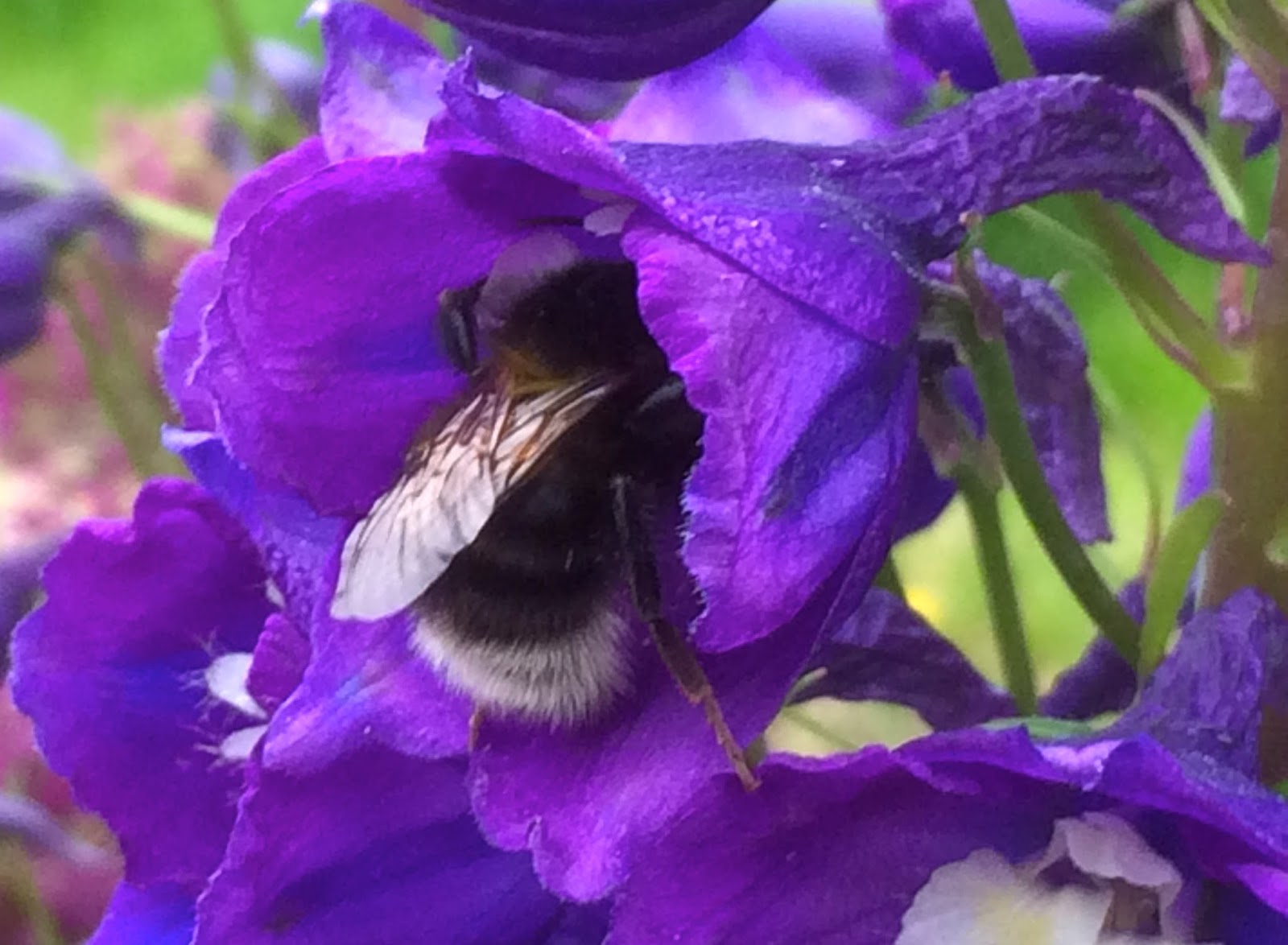
Taking care of mass Delphinium planting in the traditional way must be time-consuming. This doesn't scare me because (look away now if you are faint-hearted) I don’t stake my herbaceous perennials.... not even my delphiniums. I do, however, plant them in the least windy, most sheltered parts of the garden. After the storms which have battered us over the past few days, I had been expecting to see them slumped like a posse of teenagers over their mobile phones. I was wrong. These sturdy plants are dancers with serious core strength. They might not be as ramrod straight as those we see at flower shows, but they are most certainly standing tall and strutting their stuff, despite the occasional curved stem. Most importantly, bees love them. They are as popular as Nepeta with our buzzing friends at the moment. 
June borders might be a feast for the eyes, but while I was working in the garden a few days ago, I was bowled over by the most divine scent. Following my nose I found myself face-to-flower with Abelia mosanensis. Given that the roses are all belting out fragrance at the moment, the fact that quiet little Abelia flowers managed to eclipse them says much about the beauty and strength of its scent. First discovered in Korea, this 1.5 metre high shrub is a member of the honeysuckle family. I grow it in full sun, but it will take a little shade. Its light green leaves turn shades of red and orange in autumn and best of all, it is popular with butterflies and bees. Of all the myriad flowers deserving attention in June, a quiet, humble shrub with tiny blooms wins my heart. That is as shocking as telling the teenage me that there are more desirable plants than a limp Gladiolus which has been flailed about the stage by Morrissey.* 

*Just in case you are too young to remember.... https://www.youtube.com/watch?v=1PV4eiDi12w

Prince Charles on Gardeners' Question Time http://www.bbc.co.uk/programmes/b074zy95

I am joining with http://www.maydreamsgardens.com/ for Garden Bloggers' Bloom Day. Why not head over there and see what is blooming in June around the globe?


Tuesday, 15 September 2015

If Bees and Butterflies Gardened

1980s fashion is making a comeback. Incredible though it might seem, one of my daughters has proudly claimed ownership of some of my old clothes! 
30-year-old 501s no less, or should I say pre-loved vintage jeans? Suddenly I feel in tune with today’s teens, which is a welcome change, because usually I am at odds with them due to my lack of Kardashian general knowledge and a prehistoric preference for gardening blogs over make-up vlogs.


Sometimes I find my tastes at odds with pollinators too. I may bill and coo over a spectacular bloom, but the pollinators might have other ideas, lavishing all their attention on a gentler, quieter flower. These plants are easy to overlook, especially if they bloom all summer and continue into autumn with little intervention from the gardener. One such long flowering perennial is Scabiosa columbaria subsp. ochroleuca. For the past fourteen weeks, bees and butterflies have been lavishing their attention upon its flowers. Fourteen weeks! And it will continue to flower its socks off well into October.


It is a dainty plant which prefers sun and well-drained soil. Masses of delicate primrose flowers are held aloft grey-green filigree foliage by wiry stems which sway gently in the summer breeze, yet shrug off autumn storms and torrential rain. It isn’t huge; it reaches just 50-60 cm tall (20-24"); and it may be quiet, but it is tough.


I left this scabious unwatered in dry weather this year and it thrived irrespective of my lack of care. I have a number of these plants in a demanding area of our garden: the carpark. It is unfenced, so deer and rabbits can come and go as they please. They cause damage to other plants, but they have never touched this scabious.


I grow it amidst a sea of Stipa tenuissima because the border gets buffeted by fairly lively wind. Since there is little point in fighting the weather, I have celebrated its excesses with grasses and scabious. Scabiosa columbaria subsp. ochroleuca is a pretty little thing. I love looking at it every time I park my car; yet it is the flurry of pollinators around the flowers which truly drew my attention to it and helped me to appreciate the huge contribution this quiet little plant makes to the garden. If bees and butterflies could garden, they would surely grow this plant. 

I am linking with May Dream Gardens to celebrate Garden Bloggers' Bloom Day. Why not head over there and see what else is flowering today on this wonderfully diverse planet? 
http://www.maydreamsgardens.com/

Friday, 14 August 2015

New on the Menu for Bees in 2016 from Thompson & Morgan

When faced with a smörgåsbord of floral delights, which flowers are the favourites of our pollinating friends? This is something I constantly observe when visiting gardens and nurseries as it helps me to decide which plants will best broaden the nectar sources available in my own borders. I am always on the lookout for new plants, so I was delighted to visit Thompson & Morgan’s Open Garden at Jimmy’s Farm in Suffolk to take a look at some new introductions.

Thompson & Morgan's Open Garden at Jimmy's Farm
Scabious are excellent bee plants and Scabiosa 'Kudos' is no exception. This new pink cultivar, described as virus free (presumably from cucumber mosaic virus, which can be a problem for scabious), looked delightful in a pot at the open garden, although I would gladly give this gorgeous plant plenty of border space.


2016 will be the Fleuroselect Year of the Cosmos and the party has started early at Thompson & Morgan's Open Garden. I posted photos of lovely pink Cosmos bipinnatus 'Cupcakes' last August and this year 'Cupcakes White' really grabbed my attention. I am clearly not the only fan of these beauties. Stocks of 'Cupcakes' sold out before the end of the spring sowing season this year and it is thought that only small quantities of seed will be released for the 2016 season, since bulking up stocks of new varieties takes time. If you are fortunate enough to grow this plant, it will be worth saving some seed for next year.


In this Cosmos celebration, Cosmos rubiata made an attractive and popular addition to the bee's buffet with its maroon blooms fading to pink, giving different shades of flowers on the same plant. 


I am a fan of foxgloves, so I was interested to see Digitalis hybrida 'Polkadot Petra', which is a hybrid perennial foxglove from Thompson & Morgan's breeding program. It is a shrubby plant which flowers over a long period and I am told that it is more hardy than 'Illumination'. 


I cannot remember having ever grown Zinnia. I have admired the flowers in other people's gardens for years, but was finally persuaded to add them to my seed list for 2016 when I saw Zinnia elegans 'Cupids Mix' strutting its stuff. This 50cm (20") tall plant was proving to be a spectacular bee magnet, and all for the price of a packet of seeds. 


In the UK we have surprisingly few native plants. Happily, we are able to grow hybrids and a vast variety of plants from around the globe which offer food and shelter to wildlife. As I sit at my desk, looking out over a lavender border brimming with butterflies and bees, I cannot imagine being without non-native plants and hybrids. Of course I grow native plants, but I wouldn't want a garden where I couldn't try out new introductions and expand the nectar sources available to pollinators. I am always grateful to those who breed good garden plants, for their success breathes new life into my borders. 


Tuesday, 6 January 2015

Garden Gatecrashers

I have been digging up dandelions with roots like tree trunks and I have come to the conclusion that dandelions are the glitter of the weed world. When we are children, glitter is fun and we scatter it hither and thither. Then we grow up. Suddenly a fleck of glitter becomes a source of irritation and we realise that one fabulous fling with the sparkly stuff over Christmas will still be haunting us in mid-July.

Once upon a time I loved dandelions. They were an unending source of food and fun (unending being the operative word). When we weren’t feeding the leaves to any pet showing a slight inclination towards them, we were aiding the propagation of dandelions (as if they needed it) by blowing on dandelion clocks as a means of finding out the time. How often we needed to know the time! 


I am ashamed to admit that once I was the parent in charge of cutting and sticking, I swiftly replaced tubes of glitter with glitter glue, which still managed to adhere itself to the end of my nose all day long making me look a tad less professional that I might have liked, but at least it didn’t turn up unbidden on the sofa in the height of summer. Even worse, my children were discouraged from using dandelions as time pieces as I explained rather dryly about them being weeds. What a miserable parent. 


Now I am wondering where my love for dandelions went. Let’s face it, they might be considered attractive; they are valuable to pollinating insects; they have pretty seed heads; they are robust; they add year-round interest; they are rich in nutritional value; they make a handy, if unreliable time piece; and children love them. If this were the description of a border plant, we would all be chomping at the bit to grow Taraxacum officinale.


My new year’s resolution is to learn to love my weeds. It’s a tough task in the case of the dandelion, but as I try to dislodge those almighty tap roots from between two bricks (how do they always do that?) I am discovering a grudging respect for them. Learning to love, or at least respect my weeds is making the issue of tackling them less fraught. Whether you view weeds as a challenge; a mildly irritating addition to your long list of gardening tasks; or an overwhelming threat requiring you to rush indoors and put on the kettle (not as a mode of weed control, but because we Brits like a cup of tea in a crisis) in the words of Arnold Schwarzenegger, they “will be back”. After all, one year's seed is seven years' weeds and while you might not dream of allowing a single weed to set seed in your garden, your neighbour might be less than vigilant in the weeding department. Then there is the messy issue of seeds dispersed by birds, like bramble. 


Ah blackberries.... there is so much to love about the humble bramble! Shocking as it might sound, there are weeds about which I actively do nothing (this is my kind of activity). Take nettles, I know they can be a pain, but I always like to keep a few patches for butterflies along with a lovely clump of thistles. I adore thistles! A wayward thistle is easy enough to weed out, but when the thistle patch is smothered in butterflies, it is a joy to behold. It doesn’t stop there (the tidier gardeners among you may wish to lie down at this point). I leave thistles to seed so that they can be swooped upon by marauding finches. 


I live in the countryside and my thistle patch upsets no one. I would not necessarily encourage thistles everywhere and while I am learning to love my weeds, I am always mindful that there are some weeds which mustn’t be ignored. Some of them call for immediate action and official notification depending upon where you live. Thankfully the majority of weeds don’t fall into this category and it is this group of garden gatecrashers which I have this year resolved to love or respect.... or at least to stop calling them rude names.


Of course, weeds shouldn't be too much of a problem until they start into active growth in spring, so I am hoping to be able to stick to my resolution until at least the end of January.

Wishing you a very happy new year. May all your gardens flourish and may all your pests be little ones. Oh... that doesn’t work. Happy new year anyway.

All the photos are of weeds I loved in my garden last year.... and a dandelion. 

Friday, 14 February 2014

Triumphant Teasel and the Great Cheese Challenge

There are 700 named cheeses produced in Britain and I am on a mission to try them all. Fellow cheese fanciers will understand that the magnitude of this task might prevent a blogger from posting for a good few weeks. For those 
non-turophiles among you, my feeble excuse for posting absolutely nothing of late is that we moved into a house without a phone line. (Thankfully the property was fitted with a fully functioning fridge filled with cheese, so I used my time wisely).


Perfect conditions for a move
We awoke for the first time in our new home on Christmas Eve and although there is still plumbing* and door hanging to complete, we do at last have Wi-Fi, so I am back in the blogosphere and having a fascinating time catching up with your posts.


home heaving with builders is hardly a relaxing place to hibernate with a laptop, so occasionally I feel obliged to peel myself away from the screen and work off my cheese hips in the garden. I refrain from tidying borders until spring as seed heads provide nutritious food for birds and once the seeds are gone, the husks and broken stems make excellent minibeast and ladybird sanctuaries. Consequently, at this time of year I focus my gardening efforts on that exhausting duo of calorie burners: staring at borders and compiling lists. 


My most recent border patrol had me reminiscing over the extraordinarily extended and valuable performance by Dipsacus fullonum (teasel). Although it is a plant we see growing naturally around the pond and in the paddocks, I use it in the farmhouse garden because of its significance for wildlife. It also happens to add structure to the borders for very little financial outlay and does a fabulous job of linking our garden with the countryside beyond. In summer, its nectar-rich flowers are much loved by bumble bees, hoverflies and butterflies. If you have never watched teasel come into bloom, you are missing a treat. The purple flowers open in a most intriguing order, demanding daily inspection (usually with a mug of coffee in hand) to see what is going to happen next. 


For all its fascinating unfurling, I love teasel most when it is going to seed. Glorious in the autumn sunshine, it raises its skinny teasel arms in triumph. 
Tah dah! Teasel, champion of the goldfinch seed chart and all-round good plant. Sow in spring and since teasel is a biennial, it will suppress weeds with its rosette of leaves for months on end and flower the following year, after which you will be able to marvel at your own triumphant teasel’s bulging biceps. 


For more information about beautiful British Cheese, visit http://www.britishcheese.com

Sunday, 29 September 2013

F₁ Hybrid Gardening Contortionists

Gardeners are extraordinary hybrids of the here and hence. Our feet are firmly planted in the fine tilth of today, but our brains keep galloping off to the future. My body is currently in autumn (which sounds like a comment on my age rather than the season), but my mind has been bouncing around like a lamb in spring ever since the bulb catalogues started dropping through the letter box in July, which was, of course, when the rest of my body was luxuriating in mid-summer. 


It may sound improbable when we stand up, stiff-backed after a long weeding session, but gardeners are marvellous time-flexible contortionists with futuristic heads grafted onto gardening bodies (I am now getting an image of Sarah Raven rootstock with a scion of The Jetsons). This arrangement means that we have the capacity to escape from the more challenging aspects of any season. The very notion of winter without seed catalogues makes me shiver; but if my head is in high summer, cold weather becomes more bearable.


Last winter (the one which seemed to last forever), my mind was abuzz with autumn pollinators and as a result, butterflies and bees are now enjoying Asterfest in the farmhouse garden. I have been particularly impressed with Aster amellus 'Veilchenkönigin', which is short (around 35cm), stocky and a strong violet colour; but at the moment the pollinators seem to prefer Aster amellus 'King George'.

Small Tortoiseshell on Aster amellus 'King George'
Autumn is the season of butternut squash, brambling and bulb planting. I mention butternut squash since my fondness for it may shortly be put to the test. Unless there is a catastrophic squash meltdown, we will soon be harvesting 10 socking great fruits from three 'Sweetmax' plants grown from seed sown in March. It is the first time that I have grown this variety and if it tastes good, I shall certainly sow it next year (head in spring again). 


I am unable to work out whether I am becoming more clumsy in the garden or if my manners are improving with age, but I seem to be spending an increasing amount of time apologising to plants for accidentally deadheading perfectly good flowers, or digging up bulbs. Last week, while my mind was mulling over springtime sources of nectar and pollen, I inadvertently dragged a daffodil bulb from the soil. I don’t know who looked more shocked: me; the daff; or the passers-by who overheard me begging a bulb’s pardon. Once the daff was tucked safely back in bed, I scurried, red-faced, back to the house to add Crocus tommasinianus to my plant list. Come February, the lawn will be awash with purple; bees will be blanketed in pollen; and with any luck, my blushes may finally have faded.


The hedgerow fruits are looking resplendent in the autumn sunlight and as usual the plumpest, juiciest blackberries are just out of reach. This is no bad thing because they can be enjoyed by winged wildlife and my sense of guilt about gathering berries is assuaged. Recently, I have been leaving fruit on the lower branches too, as there have been several sightings in the farm hedgerows of a rare species which migrates from its natural habitat to feast on ripe blackberries. One of my proudest photographic achievements has been capturing two of these shy creatures on camera. 


Please remember that the Lesser Spotted Onesie Brambler hunts in packs and should only be disturbed if you are in possession of a fully prepared crumble topping and custard. 

Tuesday, 30 July 2013

Welcoming Wildlife

Isn't it great when a plan starts to come together? When I began our garden last year, my main aim was to encourage wildlife by selecting plants which would offer a source of food and shelter. One year on, we are seeing a marked increase in the numbers of bees, butterflies and birds. Perhaps this is because of the weather and nothing to do with gardening, but when I go outside and find myself in a flurry of butterflies and I see them settling on plants which were selected to meet their needs, I feel certain that I have made sound choices. 


I garden organically; I have never gardened in any other way. If you should ever visit our garden, you will receive no apology for lawn weeds because we rejoice when we see bees enjoying flowering clover in our lawn and we tread very, very carefully! 

Echinops ritro
Gardening for wildlife might be my main aim, but I am selfish enough to design our garden for my requirements too. I have posted before about my need for readable structure in the garden* and although I select plants for other creatures, I want to see them arranged in a way which pleases my eye. Happily, bees and butterflies enjoy plants en masse as much as I do.

Cirsium rivulare 'Atropurpureum'
The farmhouse garden is still far from mature - a budget blown on rabbit fencing put paid to any hope of planting big specimens - but it is beginning to do its job and we have a lively garden where we can enjoy a privileged, close view of the creatures visiting the plants

Hyssopus officinalis
I feel very strongly that our decisions make a difference and while we can’t encourage wildlife in if it isn’t within sensory distance, we can welcome visiting creatures with a delicious feast, somewhere to stay and a supportive environment for any offspring.

Knautia macedonica
My next challenge is to try to ensure food and shelter for wildlife all year round and I hope you will forgive me if I return each month to this subject which is so important to me. I am fascinated to hear about any plants you have found to be particularly attractive to beneficial insects and other wildlife Meanwhile, I will grab myself a coffee and take a few minutes to enjoy the company of today's garden guests.  

* The structure rant can be found at: