Showing posts with label GBBD. Show all posts

Friday, 15 September 2017

Garden Bloggers' Bloom Day - An Annual Event

Every year I grow a handful of annuals to plug the gaps in my garden, and in September they strut their stuff as if there is no tomorrow. Which, in the event of an early autumn, is tragically the case. Perhaps I should elevate annuals beyond gap-plugging, but I love using them to lift a dull corner of the garden or to add a new dimension to permanent schemes so that each border is slightly different every year.
Cosmos bipinnatus 'Cupcakes'
Cosmos is a stalwart of the garden gap. This year I stuck to Cosmos bipinnatus 'Cupcakes' with its remarkable unbroken single petal. It might be beautiful but I should have known better than to attempt to grow a plant with baking connotations. Needless to say 'Cupcakes' turned out like many of my culinary efforts: disappointing. For every light fluffy sponge, there were at least three flops failing to develop that gorgeous cupcake shape. 
Cosmos bipinnatus 'Cupcakes'
I accept that I am no Mary Berry, but for once I am unable to blame my culinary inadequacies. Perhaps other seeds infiltrated the batch, or 'Cupcakes' isn't as stable as we would hope. Either way, I have some very ordinary looking Cosmos among the cakes. It's like getting turnip surprise when you’re looking forward to double chocolate gooey pud with cream and custard. I might be disappointed, but the bees like the flops. Then again, more cupcakes might have made us all happy. 
Persicaria orientalis
A year ago today I posted about my hope that Persicaria orientalis would do the decent thing and seed itself around*. The good news is that it has! The even better news is that it relocates well. I have dug up a number of plants and placed them where I want them and they have all thrived, although they are shorter than their parents, unlike one particular Nicotiana affinis. It has reached dizzying heights by comparison to its bedfellows and would give Nicotiana sylvestris a run for its money. 
Nicotiana reaching for the sky
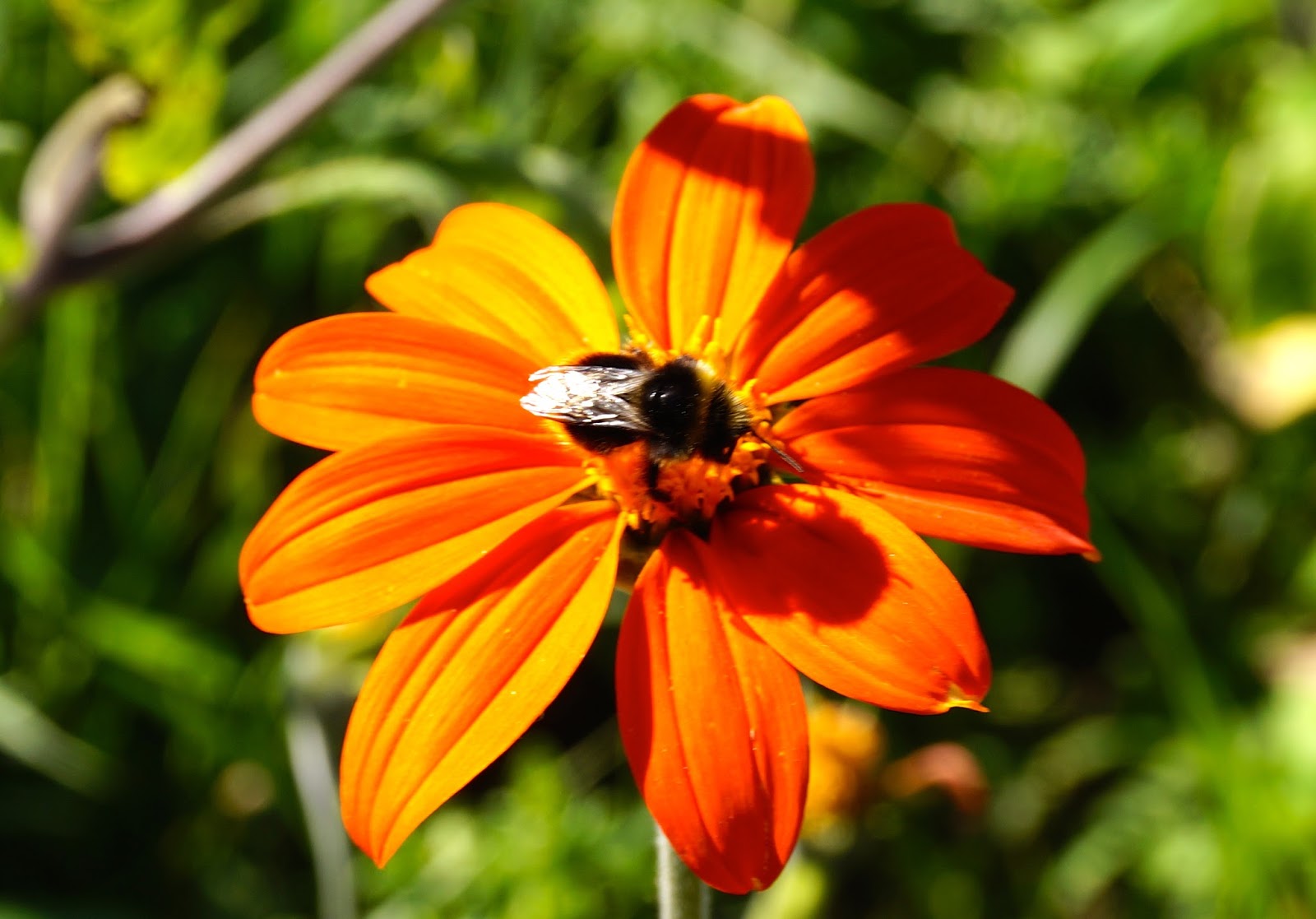
Tithonia rotundifolia 'Torch' has exceeded my expectations. This huge, glorious clump of shining orange blooms towers over the sunflowers that are hanging their heads in deference to its marvellousness. Who can blame them? Even the wind and rain won't stand in the way of tithonia's magnificent display.
Tithonia rotundifolia 'Torch'

Zinnia elegans 'State Fair' has been brightening up a dull corner for weeks. Next year I plan to sow more. I had intended to add these beauties to the cutting garden, but got sidetracked on the walk there by some Zinnia-sized gaps in the border. 
Zinnia 'State Fair'

Cosmos was destined for the cutting garden too and fell into a gap in the border en route. Seeds were more successful in getting to the cutting garden. Marigolds and cornflowers are mingling together and look particularly loved-up.
I have cut very few cornflowers because they are so popular with bees, yet all of these annuals have been used at some time in flower arrangements this summer. They have made such a difference in the garden and indoors. I really should sow a greater variety of them in future. Which annuals do you use for plugging border gaps and flower arranging?

*http://thegardeningshoe.blogspot.co.uk/2016/09/twenty-first-century-gardeners.html

I am linking this post with Garden Bloggers' Bloom Day, hosted by Carol at http://www.maydreamsgardens.com/
Why not pop over there and see what is blooming in gardens elsewhere in the world?

Monday, 15 May 2017

Garden Bloggers' Bloom Day

Like many bloggers, I post elsewhere from time to time. One of my regular haunts is The Hardy Plant Society Blog where I post every month about fabulous plants for pollinators. 

Here is my latest offering: http://www.hardy-plant.org.uk/blog/shoe-0517 
I hope that you enjoy it. 


My apologies for redirecting you today. I will be back here next week, by which time, fingers crossed, we might have had some rain in Norfolk. The soil is so worryingly dry!
Best wishes,
Sarah


More gorgeous blooms in gardens around the globe may be found at http://www.maydreamsgardens.com/

Wednesday, 15 February 2017

February Flowers for Bees

While weeding a border yesterday, I was dragged from my winter torpor by a passing bee. Without a second thought for the hot drink I had been promising myself, I pursued the bee to see where it might be heading. 
There is plenty on the menu for early bees. Sitting prettily just above the surface of the soil are snowdrops, Crocus and Iris reticulataHellebores hang their heads shyly, as if scared to be noticed. Who can blame them when they are towered over by winter flowering shrubs pumping out great nostril-loads of scent and screaming for attention?
Snowdrops growing through Ivy. A match made in heaven

I do love a scented shrub. At the moment, the sweetest of the fragrance factories are the shrubby honeysuckles, Lonicera fragrantissima and Lonicera x purpusii 'Winter Beauty'. Flowering from January to March in my garden, they are a valuable source of nectar for early bumble bees. Delicate creamy-white flowers hang on almost leafless branches. Their scent is not as heady as Sarcococca which is belting out fragrance at the moment, but Lonicera certainly packs enough of a punch to get attention. 
Lonicera fragrantissima grows to about two metres, so it needs space. It might be big, but it is not a dense shrub and it looks great with winter flowering bulbs and hellebores at its feet. Later in the year, dark green hellebore leaves make a wonderful foil for the lighter leaves of Lonicera
Crocus brightening up the car park border
Happy in sun or part shade, if there isn't room to let it romp, it may be grown as a wall shrub, but take care not to over-prune. I only ever trim a branch if it is encroaching on a path. I certainly wouldn't cut away more than two or three branches in any one year. Pruning should be undertaken straight after flowering. 
Lonicera x purpusii 'Winter Beauty' has purple-red stems in spring and early summer. I can't say that this makes a great deal of difference to me as it like the flowers, foliage and the form of both Lonicera fragrantissima and Lonicera x purpusii 'Winter Beauty'. Best of all, they get the bee seal of approval.

I am joining with other bloggers around the world to celebrate Garden Bloggers' Bloom Day. Why not pop over to http://www.maydreamsgardens.com and see what is blooming in gardens around the globe?

Thursday, 15 September 2016

Twenty-First-Century Gardeners

The twenty-fifth anniversary of the internet set me thinking about the ways in which technology has impacted gardeners' lives. Once upon a time I gardened in isolation and on occasions I was fortunate to share my enthusiasm for plants with 3 elderly gardeners. I will be forever grateful for their company, encouragement, advice, seeds and cuttings. Twenty-first-century gardening needs not be a solitary experience. I might garden alone, but within seconds I can share my latest horticultural triumph or crop failure with thousands of fellow gardeners and receive advice, support, sympathy, and on those rare occasions when the going is good, a virtual pat on the back.
Ulting Wick Garden 2015
If your nearest and dearest are not nuts about gardening, meeting fellow gardeners and spending a few hours indulging in plant talk is a great luxury. In the UK, members of All Horts, an online group, arrange garden visits and invite fellow members to join them. It was during one such visit to Philippa Burrough’s wonderful garden at Ulting Wick in Essex, that I met Persicaria orientalis. I also met gardening enthusiast and fellow Twitterer, @ToBoldlyGrow, who admired the Persicaria in Philippa's garden and decided to start some from seed. Earlier this year, along with other wonderful plants which he had grown, he gave me some Persicaria orientalis.
Ulting Wick Garden 2015
Persicaria orientalis is an annual with the splendid common name of kiss-me-over-the-garden-gate. I planted it opposite my garden gate, not because I was optimistic of a kiss, but because I wanted to see it every time I went out or arrived home. In any case, I would need a ladder for kissing because the gate is taller than me, and kissing atop a ladder is a folly even in the first throes of love. Persicaria orientalis' rate of growth is impressive. It has managed to reach at least 1.5 metres (around 5’) since I settled it into its new home in June. It likes full sun and well-drained, dry soil, which is as well, because the soil has most definitely been dry this summer. It will flower until the first frosts and I am hoping that it will do the decent thing and seed itself about.
Persicaria orientalis at Le Grys Farm
In return for Persicaria orientalis, I gave @ToBoldlyGrow some Tithonia 'Orange Sunshine' plants. I might not have grown Tithonia if it wasn’t for Jason, who blogs at Gardeninacity. Jason lives thousands of miles away from me. We have never met, but his enthusiasm for Tithonia is contagious, so I sowed some seeds. These wonderful bee magnets are now growing in my garden, in @ToBoldlyGrow's garden, and in his sister's garden too, both of which are over a hundred miles away from mine. Without the internet, none of this would have happened.
Tithonia 'Orange Sunshine' at Le Grys Farm
We might be aiming for a paperless society, but most companies continue to produce mouth-watering glossy photo-packed catalogues to be savoured and drooled over during those long dark days, when the sun barely shines and we are up to our crowns in thermals. Researching plants, whether on those pages or not, takes little effort these days. It certainly makes the quest for rarer varieties less arduous than it was in the last century. 
Ulting Wick Garden 2015
The search for a plant will often lead us to untried nurseries and should all go well (and in the history of my extensive shopping experience, it always has), a lifelong relationship with these nurseries will soon be formed. In the UK, we are blessed with the Independent Plant Nurseries Guide, an online resource which came about in response to a thoughtless, throwaway comment by a well-known gardening presenter earlier this year. Three passionate plants-people took action to repair any damage caused by his comment, and now we are blessed with an ever-increasing list of nurseries. How I would love to visit them all!
Ulting Wick Garden 2015
I recently had the pleasure of meeting some fellow garden bloggers. We are all members of the Twitter- and Facebook-based group, Garden Bloggers. We receive support from one another, discuss blogging issues and, as it turns out from our meeting, share seeds and books. I was delighted to receive Glass Gem Corn seed from James, who blogs at Reflections On The Dew Pond. Having never grown Glass Gem Corn, I am really looking forward to trying it next year.
Ulting Wick Garden 2015
The first social media site was launched in 1997; blogging also dates back to the '90s. My children were born in the twenty-first century. They are teenagers who have never known a world without the internet, social media, or blogging. Like many families, we have rules about mobile phone manners, but at some time every day, I will see them with their heads bowed over their phones as they plan their social lives and share experiences with their friends far away, and I wonder how they could have ever managed without the internet. Then I look at myself and wonder how on earth I survived without it for so long.


I am linking this post to Garden Bloggers' Bloom Day to share the joys of Persicaria orientalis and Tithonia 'Orange Sunshine', which are both blooming their socks off in my garden at the moment. Why not pop over to http://www.maydreamsgardens.com/ to see what is blooming elsewhere around the globe?

More information about the garden at Ulting Wick may be found at  http://www.ultingwickgarden.co.uk/
The Independent Plant Nurseries Guide: http://independentplantnurseriesguide.uk/
Jason blogs at https://gardeninacity.wordpress.com/ and James may be found at 
https://reflectionsonthedewpond.wordpress.com/

Wednesday, 15 June 2016

Prince Charles, The Smiths and a Passion for Podcasts

There was a time when I would have cranked up the volume on my car cassette player and sung my heart out to the strains of The Smiths. These days, although I am still prone to a spot of singalongaSmiths while driving, I am more likely to be clinging onto every word of a gardening podcast. My addiction to podcasts is interfering with my social life. Lingering post-lift conversations are a thing of the past as passengers are hastily disgorged from my vehicle so that I can settle selfishly into Gardeners' Question Time and similar treasures.
It was during one of these blissful solitary podcastly moments that I heard Prince Charles speaking about his love of delphiniums and how he would like to see battalions of them. Why wouldn't he? Three delphiniums make a handsome group, but a multitude of them yomping through the borders must be a marvellous thing. I prefer to think of them as a corps de ballet dancing through my garden rather than a battalion storming my barbecue area, but that aside, he and I are clearly of a single mind when it comes to beloved plants: more is most definitely more.
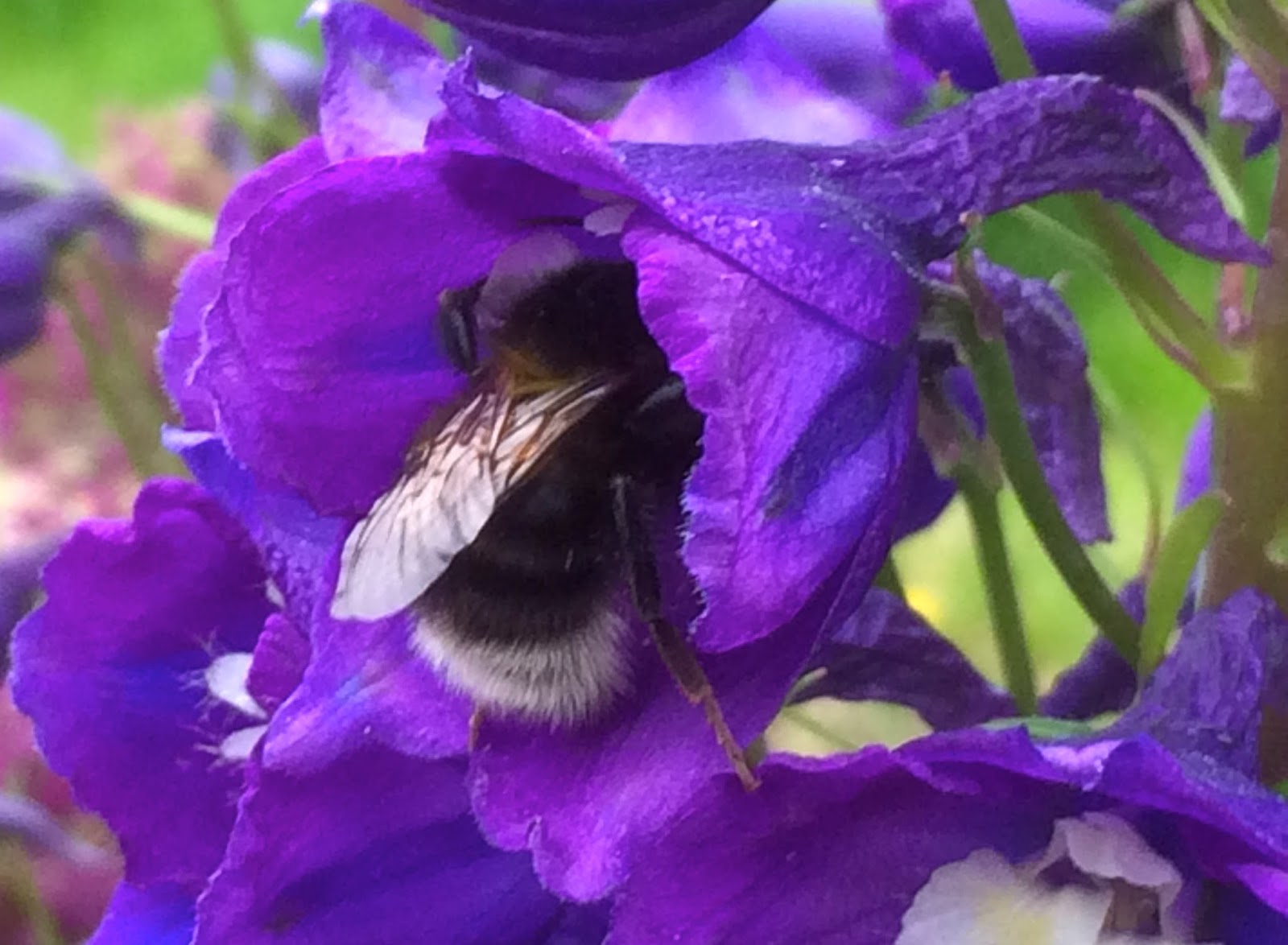
Taking care of mass Delphinium planting in the traditional way must be time-consuming. This doesn't scare me because (look away now if you are faint-hearted) I don’t stake my herbaceous perennials.... not even my delphiniums. I do, however, plant them in the least windy, most sheltered parts of the garden. After the storms which have battered us over the past few days, I had been expecting to see them slumped like a posse of teenagers over their mobile phones. I was wrong. These sturdy plants are dancers with serious core strength. They might not be as ramrod straight as those we see at flower shows, but they are most certainly standing tall and strutting their stuff, despite the occasional curved stem. Most importantly, bees love them. They are as popular as Nepeta with our buzzing friends at the moment. 
June borders might be a feast for the eyes, but while I was working in the garden a few days ago, I was bowled over by the most divine scent. Following my nose I found myself face-to-flower with Abelia mosanensis. Given that the roses are all belting out fragrance at the moment, the fact that quiet little Abelia flowers managed to eclipse them says much about the beauty and strength of its scent. First discovered in Korea, this 1.5 metre high shrub is a member of the honeysuckle family. I grow it in full sun, but it will take a little shade. Its light green leaves turn shades of red and orange in autumn and best of all, it is popular with butterflies and bees. Of all the myriad flowers deserving attention in June, a quiet, humble shrub with tiny blooms wins my heart. That is as shocking as telling the teenage me that there are more desirable plants than a limp Gladiolus which has been flailed about the stage by Morrissey.* 

*Just in case you are too young to remember.... https://www.youtube.com/watch?v=1PV4eiDi12w

Prince Charles on Gardeners' Question Time http://www.bbc.co.uk/programmes/b074zy95

I am joining with http://www.maydreamsgardens.com/ for Garden Bloggers' Bloom Day. Why not head over there and see what is blooming in June around the globe?


Tuesday, 15 March 2016

On the Menu for Bees in March

When it comes to beauties with unfortunate names, common lungwort has to win the prize. Even its Latin name, Pulmonaria officinalis - pulmo - pertaining to the lungs and officinalis - of the shop (and they don’t mean Harrods), hardly conjures up images of the heavenly flowers gracing my garden at the moment. Were our antecedents so preoccupied with leaves like diseased lungs that they failed to notice the blooms? Someone's forebears must have looked at this charming little plant and thought not of its delightful flowers or (thankfully) ulcerated lungs, but of its speckled leaves being spattered by the Virgin Mary’s milk. Consequently Pulmonaria is blessed with a number of biblically-related monikers including the rather unimaginative, ‘Mary-spilt-the-milk’. As common names go, it is an improvement on lungwort, but it is hardly in the league of beauty berry or pearl everlasting.
Pulmonaria 'Diana Clare'
Not all pulmonarias have leaves speckled with milk; 'Blue Ensign' for example has plain dark green foliage and 'Diana Clare' makes rosettes of silvery leaves with green edges. Pulmonarias thrive in pretty much any soil in dappled shade; some forms will cope with heavy shade. The key is that the soil must be moist, but not waterlogged. Too dry, and Pulmonaria may fall prey to powdery mildew.
Pulmonaria officinalis Cambridge Blue Group
At 25-30cm tall (10-12") it makes a superb ground cover plant. It is non-invasive, semi-evergreen and will even grow under Juglans nigra (the black walnut). I don't mollycoddle Pulmonaria; our clay soil suits them and all I have to do is cut back the foliage and seed heads after flowering, give the plants a little fish, blood and bone and leave them to get on with the business of growing their summer foliage.
Pulmonaria 'Sissinghurst White'
Pulmonaria is a member of the borage family (borage is not the prettiest word in the world, which proves, were proof required, that there is no avoiding unattractive names if you are a lungwort). As we might expect from a borage family member, the flowers are nectar-rich and attractive to bees. 
Pulmonaria 'Diana Clare'
The different colours of blooms indicate the various stages in the development of the flowers. It is thought that this is a signal to pollinators so that they know exactly which flowers are ripe for pollination. How clever is that? If flowers had brains, Pulmonaria would be a fully paid-up member of Mensa. Beauty and brains... it's just a shame about the name, but in the words of Meat Loaf, ‘Two out of three ain’t bad’.


I am joining with Garden Bloggers' Bloom Day which is hosted by Carol at http://www.maydreamsgardens.com/ Why not pop over there and see what else is blooming this week in gardens around the world?

Thursday, 15 October 2015

Stephen Fry, Sexy Words and a Bundle of Autumn Roses

Some words are more fun to say than others. I have yet to meet the person who can say that flirty kiss of a word “plinth” without sounding sexy (which makes buying a kitchen more fun than it should be). Miranda Hart apparently savours a “slash” and Stephen Fry allegedly relishes a “bundle”. I, on the other hand, enjoy raising my eyebrows, outstretching my arms, bowing my head, and indulging myself in that glorious musical tongue-roller of a word with the cheeky staccato ending: "remontant" (it's even better when you curtsy as if you've just enjoyed a jolly good Gavotte).


It’s not just great fun to say. This word describes one of the more alluring characteristics of plants: their ability to flower more than once in a season. It is used particularly in conjunction with roses; and at this time of year, remontancy (not such a fun word to say) is more obvious than ever. 


'Souvenir de Saint Anne’s' is a very highly scented bourbon rose which is attractive to bees. I actually think that it looks better now than it did in summer.


Rosa 'Souvenir de Saint Anne's'
Rosa MacMillan Nurse has flowered all summer long and is showing no sign of stopping. It is scented, very disease resistant and tolerates some shade, which is as well, since it doesn't get any sun in my garden until lunch. This modern shrub rose is said to attract bees and other wildlife. I haven’t seen many bees visiting the flowers; they look quite hard work for a bee and in any case, the bees are probably sidetracked by the rose's underplanting of Nepeta racemosa 'Walker's Low'. If you live outside the UK, you might not have heard of our wonderful MacMillan Nurses. These specialist palliative care nurses who support those affected by cancer are funded by the charity, MacMillan Cancer Support.

Rosa MacMillan Nurse = 'Beamac'
Another scented modern shrub rose is 'Rose Ball'. Clusters of powder pink blooms have been adorning one of our sunnier borders all summer long. It is attractive to bees and is still flowering beautifully.

Rosa 'Rose Ball'
Rosa x odorata is a very old China rose. It is highly fragrant, tolerates some shade and is attractive to bees. 


Rosa x odorata
Elsewhere in the garden, rich autumnal hues reign, but in the borders where roses mingle with gentle blues, there is the sense of an English garden preserved in summer. I love these roses for helping to make October look like June. I also love them because they are giving me plenty of opportunity to indulge in saying my favourite word. Go on… you know you want to. Arms stretched, curtsy and... "remontant". 

I am linking to Garden Bloggers' Bloom Day, which is hosted by May Dreams Gardens. It's well worth a visit to see what is flowering around the globe at the moment http://www.maydreamsgardens.com/

For more info on MacMillan Cancer Support: http://www.macmillan.org.uk/


Tuesday, 15 September 2015

If Bees and Butterflies Gardened

1980s fashion is making a comeback. Incredible though it might seem, one of my daughters has proudly claimed ownership of some of my old clothes! 
30-year-old 501s no less, or should I say pre-loved vintage jeans? Suddenly I feel in tune with today’s teens, which is a welcome change, because usually I am at odds with them due to my lack of Kardashian general knowledge and a prehistoric preference for gardening blogs over make-up vlogs.


Sometimes I find my tastes at odds with pollinators too. I may bill and coo over a spectacular bloom, but the pollinators might have other ideas, lavishing all their attention on a gentler, quieter flower. These plants are easy to overlook, especially if they bloom all summer and continue into autumn with little intervention from the gardener. One such long flowering perennial is Scabiosa columbaria subsp. ochroleuca. For the past fourteen weeks, bees and butterflies have been lavishing their attention upon its flowers. Fourteen weeks! And it will continue to flower its socks off well into October.


It is a dainty plant which prefers sun and well-drained soil. Masses of delicate primrose flowers are held aloft grey-green filigree foliage by wiry stems which sway gently in the summer breeze, yet shrug off autumn storms and torrential rain. It isn’t huge; it reaches just 50-60 cm tall (20-24"); and it may be quiet, but it is tough.


I left this scabious unwatered in dry weather this year and it thrived irrespective of my lack of care. I have a number of these plants in a demanding area of our garden: the carpark. It is unfenced, so deer and rabbits can come and go as they please. They cause damage to other plants, but they have never touched this scabious.


I grow it amidst a sea of Stipa tenuissima because the border gets buffeted by fairly lively wind. Since there is little point in fighting the weather, I have celebrated its excesses with grasses and scabious. Scabiosa columbaria subsp. ochroleuca is a pretty little thing. I love looking at it every time I park my car; yet it is the flurry of pollinators around the flowers which truly drew my attention to it and helped me to appreciate the huge contribution this quiet little plant makes to the garden. If bees and butterflies could garden, they would surely grow this plant. 

I am linking with May Dream Gardens to celebrate Garden Bloggers' Bloom Day. Why not head over there and see what else is flowering today on this wonderfully diverse planet? 
http://www.maydreamsgardens.com/

Wednesday, 15 April 2015

Vita Sackville-West, a Bowl of Popcorn and a Radish

If  I could be a plant, I would be Fritillaria meleagris. Unfurling balletically from a deep sleep, stretching gracefully, then flowering sophisticatedly and elegantly. Instead I am a radish. I leap out of bed before everyone else and there is a strong chance of fieriness as I bumble around, ruddy faced, trying to get to grips with the day. Lately the days have involved chunks of time spent of turf-staring, for which I blame Fritillaria meleagris. It is all very well enjoying this plant in full flower, but missing the gentle unfurling would be a crime. 


Fritillaria meleagris is the ultimate maverick plant. For a start, it thrives where other bulbs won’t cope. If your soil is heavy and damp, rejoice and forget the grit. Just plant this fritillary deep (four times the depth of the bulb) and look forward to years of flowers. If your soil is sandy and dry, you had better enjoy this plant in someone else’s garden, because it might cope in your soil for a while, but you will need to replace the bulbs far too soon. 


Since it was first recorded as a wild flower in 1736 (it had already been recorded in gardens in 1578), Fritillaria meleagris has been the subject of debate. Is it native to England? If not, how did it get here? Did it arrive with the Romans, or is it a cheeky escapee from a Tudor garden? Mysterious Fritillaria meleagris certainly keep us guessing. Where mystery and controversy lead, bad publicity often follows; and Fritillaria meleagris is no stranger to negative press.


While the commonest common name these days is snake's head fritillary, these delightful little flowers are also known as leper lilies. There must have been plenty of bells with happy connotations clanging around in the Middle Ages, but this quiet beauty got its name because it resembled the warning bell carried by lepers. To add insult to injury, Vita Sackville-West didn't seem overly fond of Fritillaria meleagris:

And then I came to a field where the springing grass
Was dulled by the hanging cups of fritillaries
(The Land)

Oh dear. Galling as it must be to have a human radish disagree with you, I see them as jewels in the field.


Vita Sackville-West would have seen fritillaries growing in the wild; I haven't, which is one of the reasons why I value this plant so dearly. Boggy pasture was drained and cultivated to increase food production during the Second World War and fritillary meadows disappeared. What was once a common wildflower can now be seen growing naturally in just a handful of locations in Southern and Central England. 


Obviously I can’t plant a natural fritillary meadow, but I can grow these lovely bee magnets in a damp corner of the orchard. Having tried and failed with fritillaries in a previous garden, I didn’t plant too many. Happily, these fritillaries have been with me for two years now and appear to be establishing well. I grew them from bulbs for financial reasons and this revealed another of these pretty little flowers' idiosyncrasies. They might be delicate and elegant, but they grow from bulbs which bear more than a passing resemblance to popcorn. 


Fritillary meadows can be found here: http://www.wildlifetrusts.org/reserves-wildlife/great-places-see/fritillarymeadows

I am linking this post with Garden Bloggers' Bloom Day hosted by May Dreams Gardens and I will now be heading over there to see what is blooming elsewhere on the planet. Here's the link: http://www.maydreamsgardens.com/2015/04/garden-bloggers-bloom-day-april-2015.html

Sunday, 15 February 2015

On The Menu in February for Bees

I grew up in a hospitable home and while my culinary skills may never set the world alight (indeed they might arguably give the world a dicky tummy), my desire to replicate this wonderful part of my childhood extends beyond the dining table and out into the garden. I don't mean that I am in a permanent state of barbecuing, although that would be fun, rather that I like to offer food to wildlife, not just in the feeders we have dotted around the garden, but also in the form of the plants I choose to grow. 


Anemone blanda
I have seen bees or butterflies during every month in my garden, so I have challenged myself to continue to increase the quantity and variety of forage on offer all year round. It is the most wonderful way to garden. 


Choisya ternata
In any year there will be the rule breakers - those plants which strut their stuff irrespective of the fact that it isn't their turn to take centre stage. Choisya ternata appears to have given up on the concept of waiting in the wings and has reinvented itself as a year-round flowerer, as has Pyracantha. This is all marvellously above the call of duty, but who is to say that they will manage the same generosity of flowering period in the future? 

Iris reticulata
The pollinators' pantry is surprisingly well-stocked in February and it contains too many wonderful plants to focus on here, so I have selected three glorious February flowers which the bees and I couldn't live without. 

Gorgeous Galanthus
February without snowdrops is like Friday without chocolate (or any other day of the week in my humble opinion). Good old Galanthus nivalis not only raises our spirits in the darkest days of winter, these little beauties provide a valuable source of quality pollen. They flower for weeks on end, probably because pollination can be a bit hit-and-miss at this time of year given the weather and the reduced number of pollinators on the block. But when the weather is right, bees will be busy working those snowdrops and lifting our spirits even higher. If you don't already grow snowdrops, now is the time to order some and plant them 'in the green'.


Crocus tommasinianus

The Crocus lawn is coming into flower now. It is only small, but it is a valuable source of nectar and pollen for bees. Bumblebees are always the most entertaining foragers; I love to see them dive headfirst into the flowers of Crocus tommasinianusCrocus flowers close at night and bees will lie swathed in the petals until morning when they can enjoy breakfast in bed (such is the life of a queen bee). If you are able to grow Crocus and have not yet tried a mass planting of them, please think about adding Crocus tommasinianus to your autumn bulb list so that you, too, can sit with a warm drink on a sunny winter day and watch bees. I can’t recommend this pastime highly enough.


Hurrah for Hellebores (and Lonicera fragrantissima
  
in the background)
Garden blogs are usually swamped by photos of Hellebores at this time of year and for good reason: they are an all-round fabulous plant. Not only are they beautiful; their evergreen glossy foliage makes a stylish weed-suppressing ground cover and best of all, they are a valuable source of nectar for honey bees and queen bumblebees. Queen bumblebees can hibernate for up to six months. Consequently, they wake in desperate need of food. If there are no flowers and no nectar, these bees may die. Fortunately the plants which make all the difference to the bees happen to look wonderful too. Isn't gardening with wildlife in mind wonderful? 


You may rightly have spotted that the photos in this post were taken in the dark. Unfortunately I was so busy digging that I forgot to take any pictures until sundown. I am linking this post to http://www.maydreamsgardens.com/, where you will find plenty more posts written by bloggers who don't wait until dusk to photograph their plants. I am now heading over to May Dreams Gardens to see if I can steal some menu ideas for next February. Happy GBBD. 


P.S. If you want to see cute bee pictures, there's one here http://thegardeningshoe.blogspot.co.uk/2014/10/bottoms-up-bees.html