Showing posts with label Delphinium. Show all posts

Friday, 25 May 2018

Is Chelsea a Flower Show?

I may be about to commit horticultural heresy. The exhibitors at Chelsea Flower Show have wowed us with blooms grown to perfection and colour combinations to die for. We have fallen in love all over again with lupins, and drooled over myriad pinks, roses and delphiniums, but for me, once I have had my fill of beautiful flowers, the little bit of Chelsea I take home and try to apply to my own patch involves the quiet, unsung hero of flower shows: foliage. 
Flowers in Janine Crimmins' Very English Garden
Yes, I know the clue is in the name. It’s not called Chelsea Flower Show for nothing, but I wish that it could be the Chelsea Plant Show because the use of foliage is top-class. I also think that the exquisite hard landscaping should get a shout-out, as alluded to in Andrew O’Brien's excellent Gardens, Weeds and Words*, but the Chelsea Plant and Hard Landscaping Show hardly rolls off the tongue.
Chris Beardshaw's garden for NSPCC

The first-rate use of foliage in Tom Stuart-Smith's celebration of 60 years of The Weston Garden and Robert Barker’s Skin Deep Garden will live long in my memories of Chelsea 2018. Good foliage, well combined, is a feast for the eyes (and admittedly, caterpillars, rabbits, and deer, but let us not forget that flowers have their troubles too). Of course, everything is as perfect as it can be at a show. I have yet to see a hungry bunny or a ravenous deer at Chelsea, let alone a gluttonous sawfly.
Tom Stuart-Smith's Weston Garden
Leaves are workhorses. They are photosynthesis powerhouses that retire from their working lives by falling from the plant and removing waste, before rotting down to produce precious leafmould. In short, they are excretophores, which doesn't sound terribly glamorous, but leaves are capable of doing it with such panache. After all, people travel miles to admire pre-waste-disposal autumn
leaf colour. 
Robert Barker's Skin Deep Garden

Long after we’ve finished swooning over fleeting peonies, foliage will still be quietly doing its job and earning its keep in our borders. Thoughtful foliage planting can create a beautiful textural tapestry. Combine it with striking bark, and you have the recipe for a heavenly display that will continue long after the flowers have finished showing off.
Robert Barker
It might seem strange for someone besotted with wildlife to focus on foliage at a flower show instead of pollinator-friendly blooms, but where would the flowers be without  leaves? Beautifully mingling foliage combinations linger longer than purely floral planting. Leaves help to rest the eye and make an excellent foil for showier plants, all while providing valuable ground cover for wildlife and helping to suppress weeds.
Tom Stuart-Smith

Designing with foliage is not just for the ornamental garden. Creative planting may be used in the vegetable patch to great effect. Just think of the combination of corn, beans and squash in Three Sisters planting, or take a look at Mark Gregory's Welcome to Yorkshire garden at Chelsea. Why shouldn’t vegetables feed the eye as well as the belly?  
The Chelsea Flower Show is a place for perfection and dreams. While those at the Saturday sell-off may find themselves sharing a tube carriage with ramrod straight delphiniums, the rest of us leave with more portable souvenirs. In my case, it is a camera filled with inspiring foliage combinations. While foliage 
might not steal the show, its impact is huge. Chelsea is so much more than just a flower show.

*http://www.gardensweedsandwords.com/gwwblog/rhs-chelsea-flower-show-2018-1

Wednesday, 15 June 2016

Prince Charles, The Smiths and a Passion for Podcasts

There was a time when I would have cranked up the volume on my car cassette player and sung my heart out to the strains of The Smiths. These days, although I am still prone to a spot of singalongaSmiths while driving, I am more likely to be clinging onto every word of a gardening podcast. My addiction to podcasts is interfering with my social life. Lingering post-lift conversations are a thing of the past as passengers are hastily disgorged from my vehicle so that I can settle selfishly into Gardeners' Question Time and similar treasures.
It was during one of these blissful solitary podcastly moments that I heard Prince Charles speaking about his love of delphiniums and how he would like to see battalions of them. Why wouldn't he? Three delphiniums make a handsome group, but a multitude of them yomping through the borders must be a marvellous thing. I prefer to think of them as a corps de ballet dancing through my garden rather than a battalion storming my barbecue area, but that aside, he and I are clearly of a single mind when it comes to beloved plants: more is most definitely more.
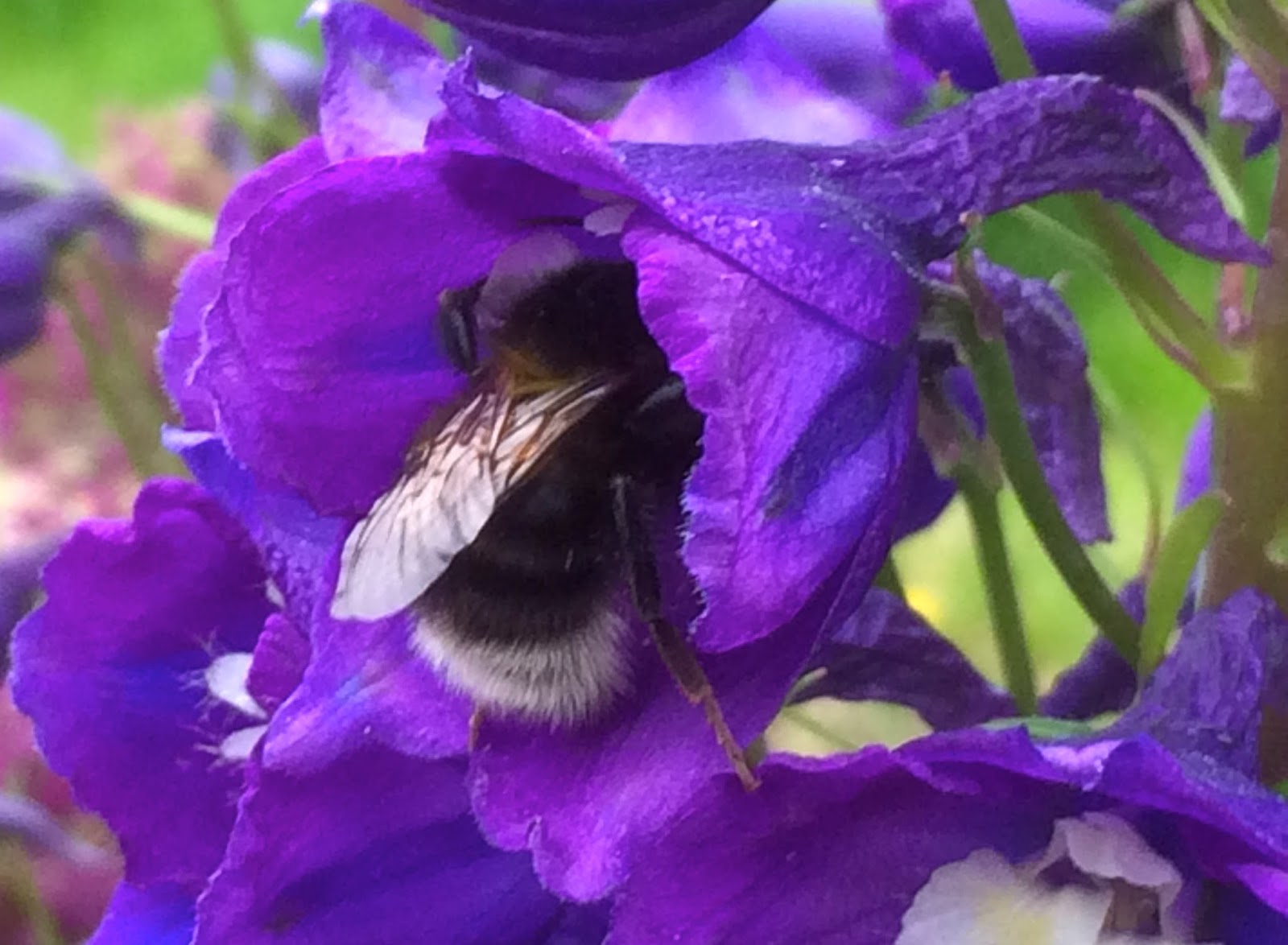
Taking care of mass Delphinium planting in the traditional way must be time-consuming. This doesn't scare me because (look away now if you are faint-hearted) I don’t stake my herbaceous perennials.... not even my delphiniums. I do, however, plant them in the least windy, most sheltered parts of the garden. After the storms which have battered us over the past few days, I had been expecting to see them slumped like a posse of teenagers over their mobile phones. I was wrong. These sturdy plants are dancers with serious core strength. They might not be as ramrod straight as those we see at flower shows, but they are most certainly standing tall and strutting their stuff, despite the occasional curved stem. Most importantly, bees love them. They are as popular as Nepeta with our buzzing friends at the moment. 
June borders might be a feast for the eyes, but while I was working in the garden a few days ago, I was bowled over by the most divine scent. Following my nose I found myself face-to-flower with Abelia mosanensis. Given that the roses are all belting out fragrance at the moment, the fact that quiet little Abelia flowers managed to eclipse them says much about the beauty and strength of its scent. First discovered in Korea, this 1.5 metre high shrub is a member of the honeysuckle family. I grow it in full sun, but it will take a little shade. Its light green leaves turn shades of red and orange in autumn and best of all, it is popular with butterflies and bees. Of all the myriad flowers deserving attention in June, a quiet, humble shrub with tiny blooms wins my heart. That is as shocking as telling the teenage me that there are more desirable plants than a limp Gladiolus which has been flailed about the stage by Morrissey.* 

*Just in case you are too young to remember.... https://www.youtube.com/watch?v=1PV4eiDi12w

Prince Charles on Gardeners' Question Time http://www.bbc.co.uk/programmes/b074zy95

I am joining with http://www.maydreamsgardens.com/ for Garden Bloggers' Bloom Day. Why not head over there and see what is blooming in June around the globe?


Saturday, 15 November 2014

Border Rebellion

Would you believe it? There are still bees bumbling about in the garden and brave butterflies are being buffeted by the autumn wind. Has nobody told them that it is mid-November in rural England?


Centaurea montana 'Alba'
I garden with wildlife in mind and spend time selecting plants so that my garden can offer year-round food sources just in case a passing creature should find itself in need of refreshment. This year, in spite of all of my painstaking planning, the plants have thrown the rule book out of the window and have decided that mid-November is the time to strut their stuff. It's a fabulous party of flowers which never usually meet. Eryngium, Chaenomeles - even spring-flowering forget-me-nots have all forgotten their slot in the gardening calendar and are joining in the fun. If they hang on a bit longer, we may discover Delphinium and snowdrops having a ball.


Astrantia major 'Venice'
To post photos of every last one of this merry band of rebels might lead to you being confronted by the longest post in the history of the blogosphere, so you will doubtless be mightily relieved to learn that I am only going to show you a small selection from this mutinous and beautiful bunch.

Cerinthe major
In the annual department, we have been enjoying Cerinthe major since March. March! For the price of a packet of seeds! Other exceptional performers which don’t know when to stop are Echium vulgare 'Blue Bedder', Cosmos bipinnatus 'Purity' and Nicotiana langsdorffii. I planted Nicotiana langsdorffii in the most windswept, inhospitable corner of the garden and it stood proud and unstaked all through summer. It remains unblemished by autumn and if we don’t get a frost soon, I suspect it might keep going into winter.

Nicotiana langsdorffii 
Of the climbers, the honeysuckles have lost all sense of timing and are continuing to bloom. Good old Lonicera x brownii ‘Dropmore Scarlet’, with its red trumpets blazing, is roaring across a rabbit fence to a family reunion with its quiet winter-flowering cousin Lonicera fragrantissima.

Lonicera fragrantissima
The flowering shrubs are showing unprecendented tenacity. Most of the Hydrangeas are sporting their lovely brown papery flower heads now, but half of the Hydrangea paniculata ‘Limelight’ plants are still in flower, with some starting to take on that tinge of pink we see as they go over. 


Hydrangea paniculata 'Limelight'
Lavandula x intermedia 'Sussex' is still throwing out new flowering stems, while Choisya ternata is showing immense confidence in British winters with masses of buds waiting to come into flower alongside the blooms which are already out. Flower buds on Cistus and Helianthemum are valiantly unfurling while in the shops, Slade are belting out "Merry Christmas Everybody". Then there are the roses. Although a number of rose cultivars flower until November, Rosa 'Rose Ball' has really impressed me. It is blooming beautifully and the flowers are holding well, with only slight damage to their outer petals, despite strong winds and rain.


Rosa 'Rose Ball'
Summer-flowering perennials appear to be blissfully unaware that they are a fortnight away from being two seasons out of season. Echinops is a real bee magnet and it is still producing new flower buds. Lamium maculatum, both 'White Nancy' and 'Beacon Silver' are blooming, as is a Delphinium! My hardy Geranium collection grows by the year which is no surprise since there are so many to choose from and we have been enjoying flowers since late spring. I could have photographed any one of six cultivars in the garden today. This one is the reliable and very beautiful 'Rozanne'. 

Geranium 'Rozanne'
I suspect that this might be my favourite ever autumn. There are seed heads and berries for the birds; pollinators have more flowers than I could have ever planned for; and frost is a distant memory.

Echinops ritro
My gratitude goes to the weather for providing a mixture of sunny and rainy shots. Special thanks go to the wind for the fuzzy photos and to the temperature for convincing the flowers that it is June. Let's face it, if you were an Echinops, would you go to the trouble of throwing out a new flower spike if you sensed frost? Without you, beautiful English weather, this post might never have been written. Thank you. 


Echium vulgare 'Blue Bedder'

I am linking this post to Garden Bloggers’ Bloom Day which is hosted by May Dreams Gardens. I am now going to grab myself a warm drink and read about what is happening in gardens around the planet. Why not put on the kettle and pop over to http://www.maydreamsgardens.com/ and see what’s happening in other gardeners’ gardens? 

Thursday, 21 August 2014

Trial, Corruption and A Few Good Plants

Gardeners are an optimistic bunch. If a crop or plant doesn't succeed in one growing season, we reason that we can always try again next year. Eventually, after another year (or years if stubbornness and tenacity are combined with our natural gardeners' optimism), we might decide to move on and when we do there is usually something new, more vigorous, sweeter, higher yielding, more floriferous, taller or more compact to try, all thanks to the huge amount of work involved in breeding, selecting and trialling plants.  


I had the immense pleasure of touring the Thompson and Morgan trial site last week. The remnants of Hurricane Bertha had swept across this secret location the day before and threw hail and thunder at us while we were there, yet the Delphinium looked splendid. These glorious Delphinium are from Terry Dowdeswell in New Zealand and they are strong growing, blackspot resistant and have well-spaced flowers. 


The site is home to an extensive collection of plants being trialled in containers. These include shrubs such as Buddleja 'Buzz' and Hydrangea paniculata ‘Sundae Fraise’ which look great in pots. Needless to say, this is a popular spot with butterflies.


I love Limonium vulgare. We see it growing in the dunes on the beaches in Norfolk and I grow it in the farmhouse borders. The problem for me is that it is so insignificant in the garden setting that it is easy to overlook. Limonium ‘Blue Velvet’ has none of these shrinking violet tendencies. It is beefy without looking as if it is pumped up with steroids and although it is a good house plant, it looks wonderful outdoors. I sincerely hope it makes it through the trials as it has been catapulted to the top of my wish list. 


The container plants at the trial site are given a liquid feed every other day. At the other extreme, those growing in the field are watered when they are planted and then left very much to their own devices. The field, with its rows of crops and flowers battling with the elements is more akin to the growing conditions in my garden, so naturally I was keen to discover how the plants there fared. The truth is that not all of them are happy, which is just as it should be, otherwise how would we gauge any improvements?


I am particularly partial to pea tips, so I would normally look upon a pea trial as a potential grazing opportunity, but since most of the peas were mildew-ridden, I was saved the embarrassment of being caught eating the trial. I wouldn't have minded some of ‘Terrain’ though, it stood out like a beacon of health in a swamp of mildew. The contrast between the plants was astonishing. 


Strangely enough, an ornamental carrot really got me drooling. The frothy burgundy flowers of Daucus carota ‘Dara’ added that intriguing combination of darkness of colour and lightness in form to the border.  Although it is ornamental it produces a white edible root, but since it is a carrot, the flowers ought to be attractive to pollinators so despite my unseemly drooling, I won't be pulling up the roots for lunch.


A plant which is definitely great for pollinators is Ageratum. I have spent the past few years feeling guilty that I don’t grow it as I sow only larger annuals. Ageratum houstonianum ‘Timeless Mixed’ which is new for 2015, is a taller version which means that I will be re-introducing Ageratum to my garden next year. It also makes a good cut flower, which will doubtless continue the Ageratum cycle of guilt when I steal stems from the pollinators to pop in a vase. 


On a happier note, Cosmos bipinnatus ‘Cupcakes’ is simply beautiful. Even a cake-shy coeliac like me will want to see these cupcakes in the garden in 2016. It is just a pity we will have to wait for so long. 


In the meantime, there are always tomatoes. In a blind taste test of five varieties, ‘sweet aperitif’ came out tops for me. It will certainly be making an appearance on my seed wish list for 2015.


During the evening after the tour, it became apparent that my camera and computer were no longer happy to communicate with one another. My camera card was corrupt and my lap top was having none of it, so I was left pictureless. My thanks go to Thompson and Morgan for supplying the wonderful photos in this post. Thank you too to Michael Perry, Kris Collins and Hannah Ashwell for a fascinating tour coupled with timely cups of tea and the sweetest of pink blueberries to nibble on. 

If you want to know more about Thompson and Morgan, they are at:
http://www.thompson-morgan.com/

If you want to read more about the day:

http://www.blackberrygarden.co.uk/2014/08/a-visit-to-thompson-and-morgan-trial.html
http://blog.plantpassion.co.uk/2014/08/great-new-cut-flower-varieties-at-the-thompson-and-morgan-trials-field.html
http://gardenerinnit.wordpress.com/2014/08/18/my-first-attempt-at-this-blogging-malarkey/
http://hoehoegrow.blogspot.co.uk/
http://vegplotting.blogspot.co.uk/