Tuesday, 23 February 2016

Going Off-Liste In The RHS Halls

February is the month when gardeners dust off their winter torpors, cast aside coffee-stained catalogues, grab their most capacious shopping bags and venture intrepidly beyond the garden gate to attend the Royal Horticultural Society’s first show of the year.
Carefully compiled shopping lists in specially selected gardening notebooks and hastily scribbled notes on the backs of envelopes are soon jettisoned in favour of a new must-have plant or garden item. It is difficult to ascertain quite what causes such retail fervour. Perhaps it is the heady scent of spring blooms, the choice plants whispering "buy me" (please don't pretend that you have never heard a plant speak) and the sudden splashes of colour which render the lists futile. I have never skied off-piste, not least because I am too scared, but when it comes to challenging pursuits such as shopping, I fearlessly venture off-liste on a regular basis. Going off-liste is a gardener’s folly and prerogative and if you can’t go off-liste at the first show of the season, then when can you? 
With all the floriferous wonder of spring filling the halls, you might imagine that I was to be seen dragging several laundry bagloads of stunners back to Norfolk; but no! My retail therapy was dramatically curtailed by Basil (the puppy, not the plant), who had travelled to London with me, although not the show (perish the thought). Since Basil is hardly pocket-sized, my shopping had to be, so I turned my back on scented Pelargonium and Pulmonaria to die for, in favour of tubers. I have enjoyed growing oca and yacon for a while now*, so I was delighted to stumble upon ulluco and mashua at the show. The ulluco tubers are pretty enough and I am excited about trying them, but they are hardly going to win the snowdrop beauty parade.
Ulluco
Oh to be a galanthophile in the wintertime! Imagine wandering into the RHS halls and coming face-to-face with the snowdrop of your dreams. I save myself a lot of heartache in the Galanthus department by examining all the price tags before looking at the snowdrops and then thinking (although not necessarily believing) that I will get as much pleasure from a glorious sunlit swathe of good old Galanthus nivalis as I will from a single, cherished, eye-wateringly expensive one. Of course, it would be lovely to have the opportunity to test this theory, so if I should ever find myself in possession of the winning lottery ticket, we can forget yachts and jets; I shall have rare snowdrops.
Gardening can be a solitary activity. This is part of its attraction for some. Time alone in the great outdoors is a pleasure to be cherished, but so is the sense of community we can find at allotments, horticultural societies, the internet, plant fairs and garden shows. If you have never been to a show or a plant fair, why not visit one near you this year? Please ensure that you take the time to compose an extensive wish list prior to your arrival at the venue. After all, if you don't know what you are supposed to be buying, how can you fully experience the guilt and joy of going off-liste?

*http://www.thegardeningshoe.blogspot.co.uk/search/label/Yacon#!http://thegardeningshoe.blogspot.com/2013/10/kitchen-garden-multitaskers.html

Details about The RHS Shows may be found here: https://www.rhs.org.uk/shows-events

Thursday, 11 February 2016

Growing Delicious Food - The Allotment Cookbook by Pete Lawrence

A friend gave up her high-powered legal job in favour of a simpler, more self-sufficient lifestyle. During the first month at home she baked every day, systematically working her way through all the cake recipes in her cookery books. Once completed, she turned her attention to chutney, which was just as well since a cake-based diet, although a marvellous thing, is not without its side effects.

Unlike my friend, I have never tried all the recipes in one chapter of a cookbook. I dip in and out of chapters - and books. There are cookery books on our shelves which have not a spatter of batter glueing their pages together. They are pristine, treasured, and the cause of merciless mockery from those who do not understand the world of the voracious recipe reader.
Given my passion for gardening and reading recipes, I was delighted to receive The Allotment Cookbook by Pete Lawrence. Pete is an award-winning executive producer who has worked with a variety of TV cooks including Nigel Slater and Nigella Lawson. For Pete, relaxation from food-related work takes the form of growing food, cooking food and writing about it. Obsessive gardeners will recognise this trait: many professionals spend weekends gardening and writing about plants, so we understand how the day job can also become a wonderful form of relaxation.
The Allotment Cookbook is not simply a collection of recipes, neither is it a gardening manual. Filled with anecdotes involving food and generations of family life, this book verges on becoming a love letter to fresh produce. It is not slushy, with the exception of the lovely rocket seedling proposal to his wife (I shall be discussing this with my other half as a standard to which he might aspire); rather it is an appreciation of the incredible positive transformation which can take place in our lives when we grow, rather than buy, our own fruit and vegetables.

   "Growing veg feels right. When you hum the same tune 
   as nature - get into its rhythm - then you will learn to    
savour produce at its very best."  - Pete Lawrence                

Pete Lawrence’s love for growing food shines through. It is a gentle, enjoyable read with delicious echoes of Nigel Slater’s writing. This book is not just for foodies and wannabe plotters, it is also a great read for experienced growers and voracious recipe readers. 
The Allotment Cookbook will not remain pristine in my house. I promise, in spite of everything stated earlier, that I will have cooked and eaten every dish in the radish and courgette sections by the end of this growing season -  not because I will be wrestling with gluts, but because I want to eat them. Roll on summer!

*Photos feature crops I have grown, picked and enjoyed eating. There would have been more strawberries and raspberries in the first picture, but they are notoriously challenging crops when it comes to picking and not eating.

Monday, 1 February 2016

New Introductions

Introducing new plants into a garden is always exciting. Sometimes the impact can outweigh the outlay because we plan and use our additional plants carefully. We might create a new focal point; add lemon flowers to lift a blue and white scheme; or increase coherence by repeating the same plant or form at intervals throughout our borders. It would be wonderful to post about a new, improved planting scheme today, but my garden is suffering from a surfeit of new introductions at the moment; and although I am very happy with them all, they are not exactly making my borders look any fuller, more beautiful or bountiful. 
RIP Herby Chicken
The first new introductions of 2016 were additional hens. Herby chicken died a few weeks ago and since a solitary chicken is such a sorry sight, I got Hippy Chick some new friends in the form of the cluckiest blue chickens in Norfolk 
(Iris and Hyacinth), and a sweet little Russian Orloff called Voddy. 
The hens had all settled in wonderfully well until I introduced a puppy called Basil into the mix yesterday. Iris and Hyacinth secured their position as top guard hens by marking his arrival with a deafening fanfare of clucking. Measures are already in place to reconcile Basil with the girls; and I am reconciling myself to more chaos than I might wish for in the Barn Garden. An eight-week-old puppy and three new chickens is not a combination famed for its positive impact on lawns and borders, but this doesn’t matter; it is a joy and a privilege to take care of animals, be they pets or wildlife. 
This is why I am not too upset about the state of Iris reticulata 'Blue Note'. I had been looking forward to a spectacular display of these beautiful flowers in the Barn Garden this year, but many of the stems have been scattered hither and thither by the hens' over-exuberant scratching. It is a small price to pay for seeing the girls happily settled in their new home. 
Wild birds have started to help themselves to our garden fare at last; I hope that they are late because there has been plenty on offer in the surrounding countryside. Plump Pyracantha berries have persisted through most of January, but they are now being eaten. I know many gardeners view Pyracantha as a mundane plant, but I could not disagree more. Not only does Pyracantha add wildlife value, with nectar-laden flowers for pollinators, juicy winter berries for birds and year-round cover, it makes a wonderful addition to more formal planting when clipped as an espalier, or trained into a grid pattern. I think it is one of the most under-appreciated plants in our gardens.
The arrival of February heralds a period of deepening envy as I read about other gardeners sowing seeds under cover. I allow myself to sow a few flower seeds which will cope with life in the cold frame as they grow, but without a greenhouse, it makes sense to wait until spring to sow many edibles. Doing nothing is incredibly hard work, but it is better than the alternative (cucumber kitchen curtains linger long in the memory*). I am optimistic that I will be so busy with Basil that I might sail through the big wait to sow this year. Here he is on his first morning with us, busily practising the important life skill of helping gardeners tidy up after themselves. This will come in useful when I introduce new plants into the borders. I shall remain optimistic regarding the length of time these new introductions will remain in the soil... there are only so many plants a puppy and a few hens can dig up, surely? 


Friday, 15 January 2016

Shrubs for all Seasons

There are many mysteries in life, like where have all the trowels, tupperware lids, single socks and left-handed gardening gloves gone? Are they being eaten in some kind of trowel/lid/clothing meal deal? And what happened to January? I don’t think anyone ate the first half of the month, although it would go a long way towards explaining my failure to post in 2016. Up there with “the dog ate my homework”, is “my sister ate the first half of January”. Not that I am suggesting that my sister, who is considerably smaller than me, could manage to eat half a month, but she is a competitive character so the merest suggestion that she couldn’t devour half a month would surely render that fortnight well and truly eaten.
I was going to share my odd sock pile with you, but
thought you might prefer a snowdrop in the rain
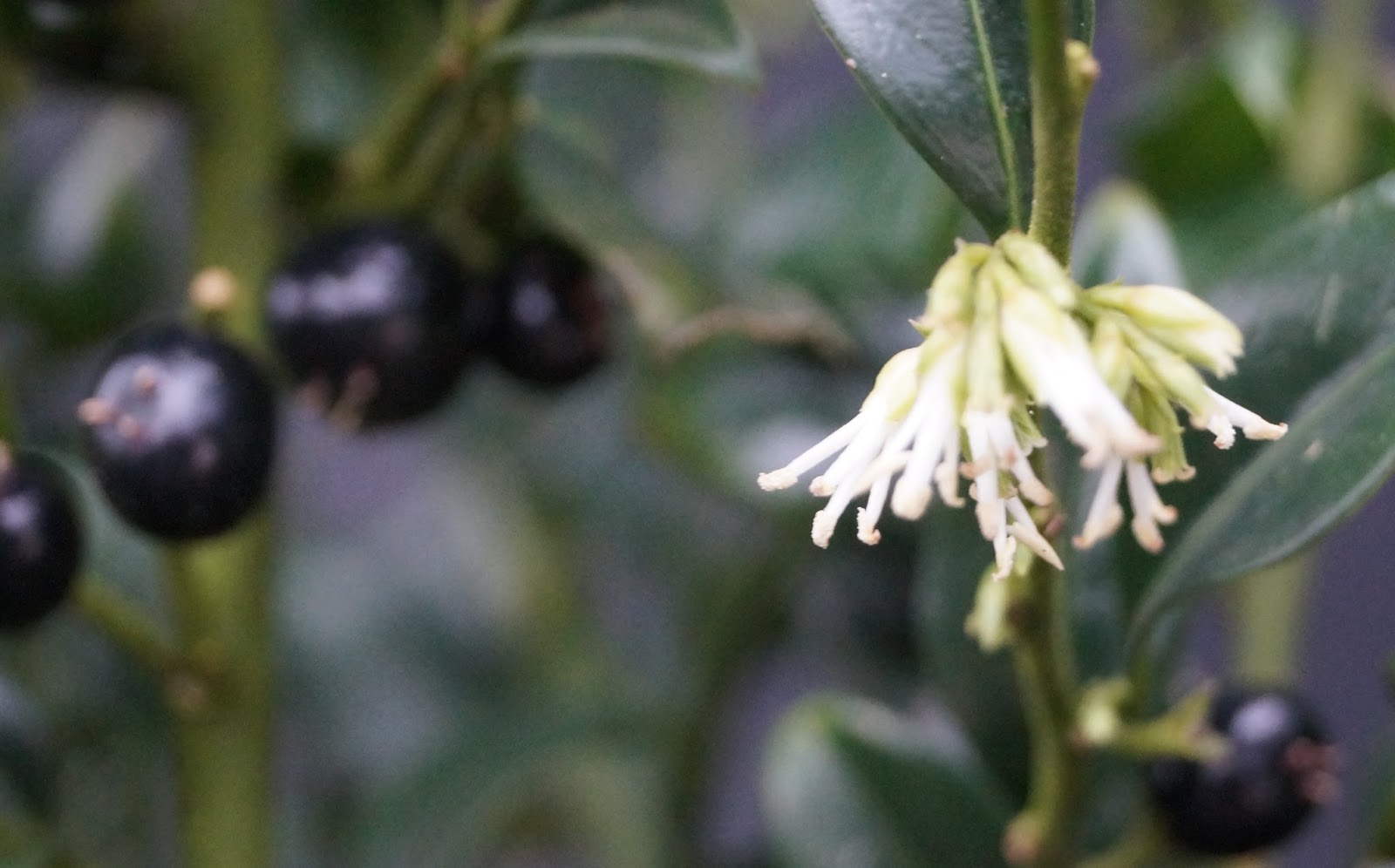
Fortunately plants get on with doing their thing irrespective of sisters eating months and my failure to post. I only have to open the door to know that one of the most useful shrubs in the garden is doing its thing at the moment, because the scent is delicious. Good old Sarcococca confusa, or sweet box as it is often known. Blooming from December to March, the flowers might be shy and hidden away in the leaf axils, but this shrub packs a punch in the olfactory department. You don't have to be a half awake bee to follow that fragrance and find these insignificant little beauties on a warm winter day.
It is evergreen, so I use it in the shadier areas of the courtyard where I want to see year round colour. Even better, it is one of the least fussy shrubs I have ever grown. I neglected one in a shady corner of a woodland in my last garden for almost a decade and it showed absolutely no signs of stress. The natural cycle of the woodland should have kept it well-nourished, but even without nature’s help, this is a plant which will put up with a surprising amount of neglect. 
Unlike the rest of the Sarcococca family, Sarcococca confusa doesn’t sucker. It will cope with pollution and tolerates dry shade wonderfully well, so it is one to consider for those tricky shady bits down the side of the house or shed. It can grow to 2m by 2m, but it does so very slowly and it isn't averse to being trimmed back. In fact, I intend to clip the groups of Sarcococca confusa in the courtyard in a similar way to Buxus sempervirens once they have reached a decent size, which may take a while, given their slow growing tendencies. If you want to clip Sarcococca confusa, do so in spring and give it a compost mulch - just because a plant will cope with neglect, doesn’t mean that we shouldn't give it a little help (this is my new year mantra and my garden is celebrating heartily).
Sarcococca and Buxus
I love plants which hold flowers and fruit at the same time. Arbutus unedo is top notch for this and so is Sarcococca. Last year's berries persist and add interest during winter, when we really notice the plant. In other seasons, the shrub makes a quiet, evergreen and rather elegant addition to the garden while it gets on with the important business of suppressing weeds, forming structure and creating a backdrop for more showy planting.  
Perfect for pots outside a shady front door, under trees, clipping into hedges, in an urban or rural setting, Sarcococca confusa makes a valuable addition to modern, slick borders as well as more traditional or natural planting. It will even cope with sun, so long as the soil is kept moist. Just because a plant is quiet and puts up with neglect, doesn’t mean that it isn’t treasured. I might forget about Sarcococca in the middle of June when brasher, showier flowers strut their stuff, but for the next three months I will be enjoying great nostril-loads of Sarcococca's beautiful fragrance and celebrating its quiet beauty every day. 

Wishing you a happy, healthy new year.

I am joining with http://www.maydreamsgardens.com/ for Garden Bloggers' Bloom Day. Why not pop over there and see what else is blooming in gardens around the planet?

Wednesday, 2 December 2015

Sowing Seeds for Wildlife and the Trouble with Hummingbirds

Seed catalogues should come with a health warning for wallets. A packet of seeds costs very little, but how often do we disappear into the magical world of glossy plant photos and find ourselves in a parallel universe where we have endless time to garden and limitless growing space? Even if our gardening lives were perfect, we would probably still be faced with a space/time dilemma if every flower, fruit and vegetable we desired leapt from the page and onto the credit card. Consequently, this time of year, which is normally associated with excess in the eating and drinking department, is a time for exercising restraint as a gardener. I am not fond of exercising - be it in a gym or restraint on the plant front - so as a reward for my sporadic gym attendance, I allow myself a little light indulgence in the form of two packets of I've-never-tried-these-before seeds per year.


Seeds purchased in one year cannot qualify as newbies the following year, so if they are any good, they are automatically transferred to the regular seed purchase list, thereby allowing space for two more packets of newbies. A problem arises if all the newbies turn out to be goodies. A decade of two successful new must-haves annually equates to twenty new seed packets in ten years (my maths genius knows no bounds). Add these seeds to those which have become essentials over the previous years of your gardening life and you have a whole load of seed packets (I am not even going to risk guessing your age, but please feel free to do your own calculation). 


Pollinator magnet Eschscholzia californica
Of course, if a plant is a consummate self-seeder, all is good and well. We buy it once and enjoy it forever. Cerinthe major falls into this category and if you have never grown it, I really recommend that you add it to your wishlist if your conditions suit. I posted about it here http://blog.thompson-morgan.com/high-value-low-cost-plants-cerinthe-major-purpurascens

Pollinator magnet Cerinthe major 'Purpurascens'
A plant which has seeded itself into the buy-once-enjoy-forever category in recent years is pollinator magnet extraordinaire, Echium vulgare ‘Blue Bedder’. Bright blue flowers emerge from pink buds and turn magenta as they fade. These breathtakingly beautiful flowers adorn bristly stems from June until at least October (by at least, I mean that they are still in flower in December this year). 


Pollinator magnet Echium vulgare 'Blue Bedder'
A dry, sunny spot suits 'Blue Bedder' perfectly. It copes near the coast, looks wonderful in a cottage garden style planting and is happy in a container. It is at home mingling with grasses and contrasts well with the soft foliage and sulphur yellow flowers of Alchemilla mollis. Sow it indoors in February and March or direct from March to May, after which, hopefully, you will not have to buy it again. It self-seeds in my garden, but not so much that I have to compost excess plants.


Echium vulgare - or viper's bugloss - is classed as a noxious weed in certain areas of the world. Here in the UK some farmers don’t like it as it can seed into fields where it puts its roots down deeply. ‘Blue Bedder’ is an annual viper's bugloss which at 45cm, is more compact and bushy than the viper's bugloss we see growing in gravel pits and along roadsides. It is hugely attractive to bees, butterflies and moths and I have read that it is a hummingbird magnet. If only we had hummingbirds in the UK... not that you would see a great photo of one if we did. I have an extensive collection of photographs of plants which a hummingbird has just left. The best I have ever managed is this. Look closely, it is there, although it might very well be a sparrow for all the detail you can see. Pitiful, isn’t it?


I am linking this post to Wildlife Wednesday which is hosted by Tina at http://mygardenersays.com/ . Do please take a trip over there to marvel at the wonderful wildlife in gardens around the planet. I guarantee that this hummingbird photo will be the worst one you will see in the whole meme *hangs head in shame.

Wednesday, 25 November 2015

The Best Day of the Gardening Year

There is a day (usually some time in February) when I take a sandwich outside and sit in the low winter sunlight. This sandwich is called the Hope of Summer Sandwich. I could give you a recipe for it, but I am no Nigella Lawson and in any case, the filling can be whatever we fancy, as long as salad is involved. Chocolate spread has never been included in the Hope of Summer Sandwich. I understand that this might appear to be a shocking omission for a chocoholic, but I am not crazy about chocolate spread and in any case, we must consider the salad element (even my relatively untrained tastebuds recognise that tomatoes do nothing for chocolate spread). 

Crocus tommasinianus
You may quite rightly be thinking that I should stop all these thoughts of bread and get out more. I agree, but I have had a brief spell in hospital and have been stuck indoors since late October. Consequently there has been plenty of time to think about food and not much time to garden, so the gardening to-do list is lengthening by the second and I may be ready for winter some time next spring. Instead of being tucked up in fertile soil, bulbs are strewn across my rather less than fertile office floor and the heating is turned down in a vain attempt to keep the bulbs happy until I am finished with the whole convalescing malarkey. As you can imagine, preserving the bulbs is playing havoc with my typing speed as my fingers are fair freezing to the keyboard - something which will not be happening when I tuck into my Hope of Summer Sandwich.

Helleborus x hybridus
The Hope of Summer Sandwich is significant because it is eaten on my very favourite day in the gardening year: the first day it is sunny enough to sit outside and perhaps even justify accessorising my lunch attire with a pair of sunglasses. It is a day which fills me with hope that summer will return and I will eventually warm through to the marrow, throw off my thermals and barbecue some corn on the cob. Even better, if it is windless and sunny enough for me to eat al fresco, there is a chance that I might be joined for lunch by an early bee.  


There are many contenders for the best day of the gardening year. Switching on the propagator should rightly be accompanied by a fanfare, champagne and a party until dawn. The first snowdrop nudging through the soil is certainly cause for a giant bar of chocolate; and the completion of just about any gardening task really ought to be celebrated with a hot coffee and a jolly good sit down. But it is that first sunny lunch time which is my favourite. It seems a little inadequate to celebrate it with a sandwich (especially as I am a coeliac and gluten-free bread is rarely delightful) but it is a decades-old tradition and it wouldn’t be right to upgrade it to something more upmarket.

Hamamelis x intermedia 'Diane'
Of course, if you live in a place where winter isn't very cold, Hope of Summer Sandwich day is not going to take priority in your gardening year. Perhaps you like the cold and the first frost of winter is a cause for celebration, but for me, much as I love the heat of summer, Hope of Summer Sandwich day is more of a cause for celebration than summer itself. 

Wednesday, 4 November 2015

Evolving Gardeners

Anyone who has ever caught a tube train in London will know that even if there is barely a square inch of floor showing in a carriage, some twinkle-toed commuter will pop their feet onto it and we will all squeeze a little closer to accommodate those parts of their body which are broader than their little toe, because there is no such thing as a full tube train. In much the same way, there is no such thing as a full garden border. The plant lover will always find room to squeeze in one more must-have plant which has leapt unbidden into the shopping trolley. I have the same problem with books. Thankfully, the introduction of e-readers has alleviated the shelf space issues caused by my fiction habit, but when it comes to gardening books, I am old-school.


The trouble with gardening books, lovely though they are, is that gardening advice changes over time. Crocks in pots are now a thing of the past; tree planting holes have changed shape; and what was once a weed might now have developed into a deeply desired wildflower. One of the most significant changes in my lifetime is the way in which we put a garden to bed for winter. Once upon a time, I might have left leaves and stems only on borderline hardy plants as a means of protection during the colder months; now I leave the stems on all of the perennials. The closest I get to an autumn tidy is harvesting the leaves off lawns and paths for my favourite crop from the garden (at least, until I work out how to grow chocolate bars) - leafmould. 

Teasel
For me, cutting back plant stems at this time of year is an opportunity lost. I care about the wildlife in my garden. Offering protection in the form of these stems is not a hardship for me, but it could mean the world to seed-eating birds or to minibeasts and (sadly for the little critters) those creatures further up the food chain who feed upon them. Before I took the decision to garden with wildlife in mind, I had started to leave a few seedheads in place, simply for the pleasure of their company over winter and to see them donning their frosty hats on a cold January morn. 

Echinops
My favourite task in the garden is cutting back spent flower stems in spring. I don’t compost them immediately; I leave them stacked neatly for a few days to give any wildlife the opportunity to move on. In spring, plants may be already coming back into growth; certainly there is barely any time to wait until fresh foliage emerges and bulbs begin to bloom. I find cutting back in autumn depressing as the tidied-up plants will not be back in growth until next year. Cutting back in spring is exhilarating because we can see something new emerging; we have something to look forward to!

Cutting back in Spring
If you are thinking about cutting back your perennials now, why not try resisting the urge? Hang up the secateurs and do something filled with hope for a new season, like planting bulbs or sowing seeds. I understand that tidy gardeners might struggle with the idea of not cutting back, but placed in the right spot, perhaps with repetition further along the border, seedheads are structurally interesting and can make pleasing design sense. You never know, if you take a chance and leave the stems, a new seedhead design opportunity might present itself. When you cut back the plants in spring, you can seize the moment to divide, replant and create your new scheme. Then you will be able to enjoy the fruits of your labours through summer, autumn and winter, while at the same time offering shelter to minibeasts; and it won't have cost you a penny.


I am linking this post with Wildlife Wednesday at http://mygardenersays.com  Why not pour yourself a drink and saunter over there to see some fabulous photos of the diverse wildlife to be found in gardens around our beautiful planet?