Wednesday, 15 June 2016

Prince Charles, The Smiths and a Passion for Podcasts

There was a time when I would have cranked up the volume on my car cassette player and sung my heart out to the strains of The Smiths. These days, although I am still prone to a spot of singalongaSmiths while driving, I am more likely to be clinging onto every word of a gardening podcast. My addiction to podcasts is interfering with my social life. Lingering post-lift conversations are a thing of the past as passengers are hastily disgorged from my vehicle so that I can settle selfishly into Gardeners' Question Time and similar treasures.
It was during one of these blissful solitary podcastly moments that I heard Prince Charles speaking about his love of delphiniums and how he would like to see battalions of them. Why wouldn't he? Three delphiniums make a handsome group, but a multitude of them yomping through the borders must be a marvellous thing. I prefer to think of them as a corps de ballet dancing through my garden rather than a battalion storming my barbecue area, but that aside, he and I are clearly of a single mind when it comes to beloved plants: more is most definitely more.
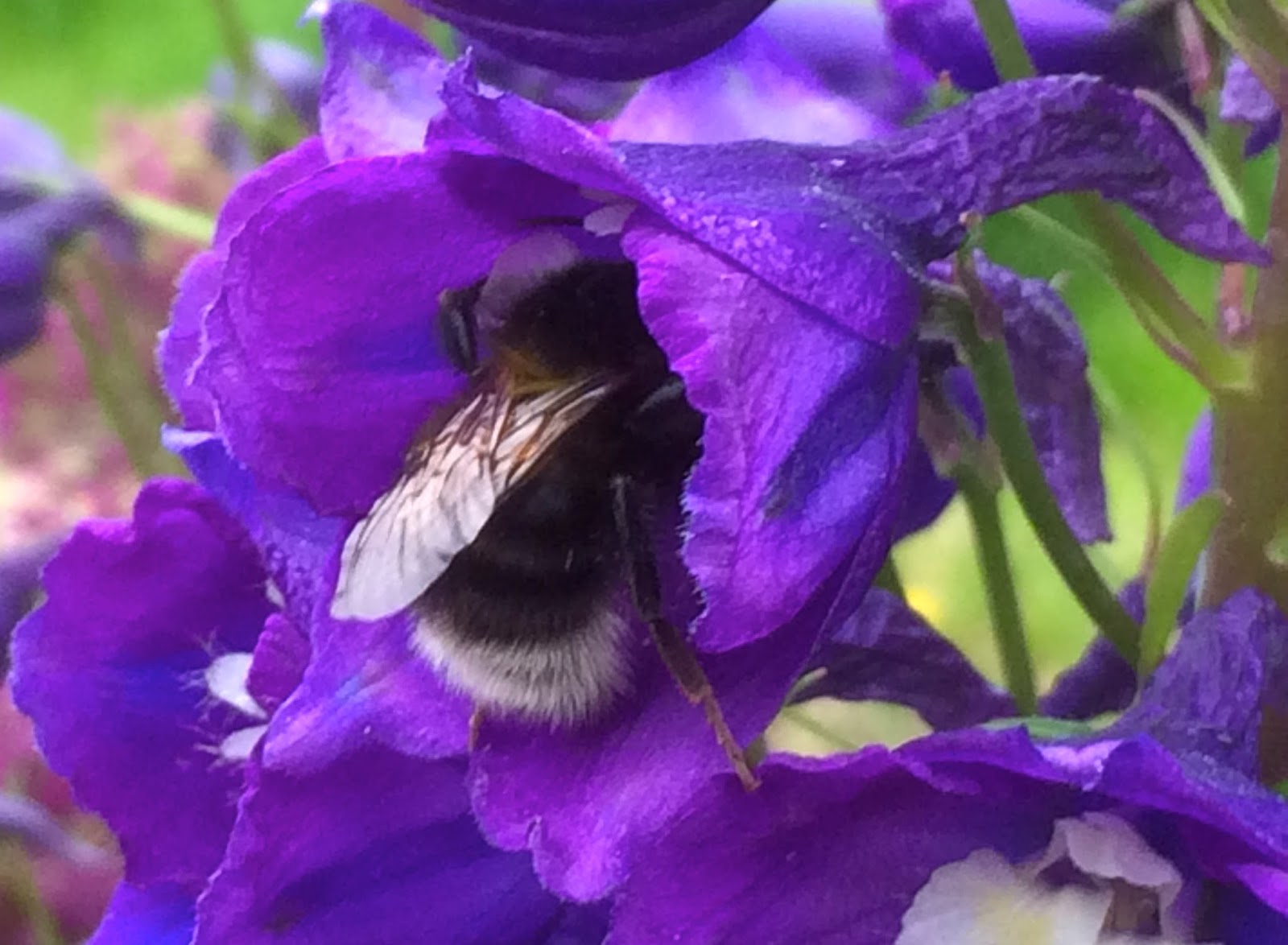
Taking care of mass Delphinium planting in the traditional way must be time-consuming. This doesn't scare me because (look away now if you are faint-hearted) I don’t stake my herbaceous perennials.... not even my delphiniums. I do, however, plant them in the least windy, most sheltered parts of the garden. After the storms which have battered us over the past few days, I had been expecting to see them slumped like a posse of teenagers over their mobile phones. I was wrong. These sturdy plants are dancers with serious core strength. They might not be as ramrod straight as those we see at flower shows, but they are most certainly standing tall and strutting their stuff, despite the occasional curved stem. Most importantly, bees love them. They are as popular as Nepeta with our buzzing friends at the moment. 
June borders might be a feast for the eyes, but while I was working in the garden a few days ago, I was bowled over by the most divine scent. Following my nose I found myself face-to-flower with Abelia mosanensis. Given that the roses are all belting out fragrance at the moment, the fact that quiet little Abelia flowers managed to eclipse them says much about the beauty and strength of its scent. First discovered in Korea, this 1.5 metre high shrub is a member of the honeysuckle family. I grow it in full sun, but it will take a little shade. Its light green leaves turn shades of red and orange in autumn and best of all, it is popular with butterflies and bees. Of all the myriad flowers deserving attention in June, a quiet, humble shrub with tiny blooms wins my heart. That is as shocking as telling the teenage me that there are more desirable plants than a limp Gladiolus which has been flailed about the stage by Morrissey.* 

*Just in case you are too young to remember.... https://www.youtube.com/watch?v=1PV4eiDi12w

Prince Charles on Gardeners' Question Time http://www.bbc.co.uk/programmes/b074zy95

I am joining with http://www.maydreamsgardens.com/ for Garden Bloggers' Bloom Day. Why not head over there and see what is blooming in June around the globe?


Wednesday, 8 June 2016

The Hopeful Kitchen Gardener

Panicking about unplanted pumpkins and runner beans with nowhere to run is an annual event in my kitchen garden. Spring-sown plants scream to be released from their pots and I can almost hear the sighs of relief every time I pop one of these poor, desperate specimens into the soil. Although everything needs to be done yesterday and the weeds will be back tomorrow, I am always filled with hope at this time of year because (with the exception of a breakout of peach leaf curl and the ongoing battle with aphids) things have yet to go catastrophically wrong in the kitchen garden.
The prettiest stage of a medlar

There were so many pollinators about in spring that I decided not to flutter around the fruit trees with my pollinating paintbrush pretending to be a bee. Unsurprisingly, the pollinators have done a fine job. Tiny embryonic fruits cluster on the branches of trees. They have yet to suffer the rigours of June drop, wasps and scab, so for the next week or two I shall remain optimistic that this autumn will be fuelled by wall-to-wall pies and crumbles.
Hope of fruit crumble, custard and cream

The hens are clearly heeding the slug and snail warning this year as their pest patrols have been ruthless. Nothing gets in their way. Last week they uprooted part of a mirabelle hedge, three asparagus plants and picked every last one of the developing gooseberries. That's one crumble I won't be enjoying this summer.
Hope of summer pudding

Images of pumpkin plants being released from the prison of their pots and spreading their roots gratefully (if indeed pumpkins feel gratitude) into delicious soil only to be dragged from their moorings by an over-exuberant hen, have led me to protect all of my crops from the chickens and rethink the whole slug control issue. 
Ever hopeful Hyacinth Hen

Fortunately my family are squirrels. That is not to say that they spend their days clinging valiantly to bird feeders and chewing on the little plastic perches, but they could quite happily live off seeds and nuts - particularly pistachios. This is great news in light of the slug and snail invasion forecast. I buy unsalted pistachios and it makes my family happy. I take the shells, scatter them around the brassicas and the slugs and snails do a runner elsewhere (hopefully into the path of a peckish hen). It takes a lot of pistachios to mulch a broccoli bed, then again, if it were left to the chickens, the broccoli would be long gone. 
Hope of pumpkin pie

While tomatoes and potatoes have yet to be blighted and courgette leaves exhibit no sign of mildew, we can remain optimistic for a bumper harvest. Early summer is a time for hope: hope that we won't be pulling pointless micro-celeriac again (what on earth happened to the celeriac last year?); hope that 2016 will be the year of the great butternut glut; and on a personal note, hope that my family's passion for pistachios will never wane.

Wednesday, 11 May 2016

Blickling Hall's English Bluebell Wood

According to my daughter (who was born in the twenty-first century and is therefore an expert in these matters), I have vlogged. It happened because I thought that you might like to hear the sound of an English Bluebell wood.


Vlogging has its shortfalls. There appears to be no share button for scent. In the absence of virtual scent, you might wish to create your own. Bluebell woods are wonderfully fragrant, but the scent is subtle and doesn't knock you sideways. If you have a few hyacinths to hand, remove them to another room and leave the door open, then place a pile of damp dirt and the odd bark chipping by your computer. Olfactory experts might describe overtones of this and undertones of that, but as far as I'm concerned it's an ambrosial dirt/wood/floral fragrance. 

Please note that considerable quantities of coffee and cake were consumed in the making of this video, so it would be entirely appropriate for you to pop the kettle on. The video doesn't last long, so in the interests of indigestion avoidance, you might want to hit the cake while it's loading. 

https://youtu.be/dlsZfghh_2M


Wednesday, 4 May 2016

The Garden Nursery

When I was six years old, I loved to tiptoe quietly into the garage to peek at the silhouettes of baby blue tits in the bird box my dad had built into our garage wall. The back of the box was glazed and covered with brown paper which gave the birds a sense of privacy while allowing us the opportunity to see something of their lives. My dad died the following spring, but the seeds of my fascination with the natural world were already sown.

Nowadays we don’t need to head into the garage to see silhouettes of chicks in a nest. For Christmas I received a bird box with a camera in it. I suspect that the gift is part of a cunning plan to encourage domesticity as the nesting box is sited directly opposite the kitchen window under which there is a sink. Since the sink is required to fill the kettle, the domesticity plan has backfired to the point that far from motivating me to attempt kitchen chores, there has been a significant increase in the quantity of time I spend sitting down. I have always drunk coffee on the hoof, but if there is any activity around the bird box while I am filling the kettle, I fire the remote at the television, plonk myself into a chair and ogle the nest while enjoying a lovely warm drink and wondering what Dad would have thought of this wireless camera bird box. 
The nest taking shape
The most astonishing accomplishment of this piece of technology is that it has caught the attention of my own offspring. Instead of the usual fare they enjoy on television, they have been spotted watching nature. Out of choice! Surely this is a healthy form of screen time?
Feathering the nest
From the comfort of the kitchen we have also been watching over a mother who hatched 11 ducklings. The nest is in the lavender which I have yet to cut back after flowering last year. I don’t cut back plants until spring because of the shelter they offer to minibeasts. I hadn't considered that the same plants might offer shelter to much larger creatures. Of course, my lavender tends to fall apart more quickly than it would had I shorn it after flowering, but it is easy to strike cuttings so I always have a ready supply. The courtyard where the ducklings hatched is a former boar pen. In the two years since it was converted into a garden, 22 ducklings have made their way into the world under the cover of the plants.
The garden feels like a dating disco. Our feathered friends are busily pairing off and doing the bird equivalent of The Birdie Song while dancing around their handbags, or in the case of Mr & Mrs Pheasant, tiptoeing through the tulips, (aptly named Tulipa 'Night Club'). At this rate - and with any luck - we will be inundated with offspring!
Mrs P doesn't look impressed. 
Perhaps she doesn't like the tulips.
There is a baby boom in my office too. Since I don't have a greenhouse, the office floor must double up as a nursery. Butternuts, tomatoes, peppers and Cosmos are jostling for light and waiting impatiently to fledge. It is hardly the ideal start for a plant, but they are safer indoors than in the cold frames where they would become frazzled with frost in no time. I rather like sharing my office with them; I only wish that the greenfly hadn't followed them in. The office greenfly are clearly very happy with the food and shelter on offer as they are procreating like it is going out of fashion. One solution will be to bring in the ladybirds. This is all putting a most unlikely slant on the notion of a busy day at the office. 

I am joining with Wildlife Wednesday at https://mygardenersays.com/ Why not pop over there, grab a drink and spend some time marvelling at the wildlife in gardens around the globe?


Monday, 4 April 2016

The Great Garden Throwback

I spent much of my childhood viewing gardens upside down. If I wasn't careering around the lawn perfecting cartwheels, I might be socialising over a weather-related handstands game which was snappily named Snow, Rain, Thunder, Lightning. The rules elude me, but I do remember that a handstand with one leg at a jaunty angle signified a lightning fork.
When my best friend and I were feeling lazy, we would dangle upside down from the frame of the garden swing; she on one side, I on the other, putting the world to rights for hours on end and wondering where Speedy my tortoise had scurried off to while we were chatting (he wasn’t called Speedy for nothing). On the rare occasions when we weren’t upside down, we would not have our feet on the ground. Why would we when we could be rockery hopping? This involved skipping from one stone to the next in the rockery, while honing our multitasking skills by having a conversation about something deep and meaningful like Abba, all while avoiding the toad which sheltered in a crevice hidden by Aubretia.
Aubretia was arguably the most ubiquitous plant of my childhood. In springtime it would be romping over rockeries and clambering over walls in the suburb I called home. Then rockeries fell out of fashion and Aubretia became the subject of mockery; the butt of jokes from plant snobs. It is highly likely that the demise of Aubretia coincided with the point at which I found my feet, gave up tumbling across lawns and became an upright citizen. Last spring, as an act of rebellion against plant snobs and the all-too-persistent passing of time, I decided to relive those glorious days of yore by growing Aubretia and attempting a handstand. Needless to say, one was more successful than the other. 

Aubretia is a top bee plant. I had toyed with the idea of growing it for a while, but because my garden is set in a flat landscape, with no rocks or walls over which Aubretia might scramble, I was concerned about where I might place it. I could have popped it in a pot and left it to escape over the side, but I keep very few plants in containers as I find them too time-consuming. I have no memory of seeing Aubretia growing anywhere other than over and down the side of things, so it was with more than a little hesitation that I placed it in a border. What on earth was I thinking? Aubretia is fabulous in a border! Instead of long (and quite frankly lanky) curtains, it forms a neat cushion. When it comes to garden soft furnishings - and if you want matching curtains and cushions - this plant is a winner! 
I grow it in an area which was once a gravel drive. The soil is thin, impoverished and alkaline. The site is the most inhospitable part of the garden. It might face south, but it is also a frost pocket which can be exceptionally windy. Despite this, Aubretia flowers shrug off the frost and the plant holds itself together, blooms for weeks on end, and is a hub of bee action on a sunny day. Clipping it after flowering keeps it neat and tidy. It really is a valuable addition to my borders and leaves me wondering why on earth a plant of this calibre was so badly maligned? 
I would love to tell you with confidence that I purchased plants from the Cascade Series, but since I am relying on my memory and the plants are cascading nowhere, I am happy to be corrected. It is unsurprising that I mislaid the plant labels given the second part of reliving my childhood. I am no Beth Tweddle, but I gave it my best shot and my children were in awe of my handstand abilities. Of course, those might have been looks of horror on their faces, but for reasons of self-esteem, I will stick with awe. Despite reaching the dizzying heights of an almost perfect handstand (dizzying being the operative word - it took quite some recovering from), I shall not be attempting another handstand in the near future, not least because I swear it took a full week for all my internal organs to work their way back to where they started. 
Clearly I made a slight error of judgement in believing that I could still achieve a handstand with any level of dignity; the garden fashionistas on the other hand made a massive mistake when they were so downright dismissive of an excellent garden plant. I am delighted to welcome Aubretia into my garden; it certainly gets the bee seal of approval. Garden fashions have a lot to answer for.

Tuesday, 15 March 2016

On the Menu for Bees in March

When it comes to beauties with unfortunate names, common lungwort has to win the prize. Even its Latin name, Pulmonaria officinalis - pulmo - pertaining to the lungs and officinalis - of the shop (and they don’t mean Harrods), hardly conjures up images of the heavenly flowers gracing my garden at the moment. Were our antecedents so preoccupied with leaves like diseased lungs that they failed to notice the blooms? Someone's forebears must have looked at this charming little plant and thought not of its delightful flowers or (thankfully) ulcerated lungs, but of its speckled leaves being spattered by the Virgin Mary’s milk. Consequently Pulmonaria is blessed with a number of biblically-related monikers including the rather unimaginative, ‘Mary-spilt-the-milk’. As common names go, it is an improvement on lungwort, but it is hardly in the league of beauty berry or pearl everlasting.
Pulmonaria 'Diana Clare'
Not all pulmonarias have leaves speckled with milk; 'Blue Ensign' for example has plain dark green foliage and 'Diana Clare' makes rosettes of silvery leaves with green edges. Pulmonarias thrive in pretty much any soil in dappled shade; some forms will cope with heavy shade. The key is that the soil must be moist, but not waterlogged. Too dry, and Pulmonaria may fall prey to powdery mildew.
Pulmonaria officinalis Cambridge Blue Group
At 25-30cm tall (10-12") it makes a superb ground cover plant. It is non-invasive, semi-evergreen and will even grow under Juglans nigra (the black walnut). I don't mollycoddle Pulmonaria; our clay soil suits them and all I have to do is cut back the foliage and seed heads after flowering, give the plants a little fish, blood and bone and leave them to get on with the business of growing their summer foliage.
Pulmonaria 'Sissinghurst White'
Pulmonaria is a member of the borage family (borage is not the prettiest word in the world, which proves, were proof required, that there is no avoiding unattractive names if you are a lungwort). As we might expect from a borage family member, the flowers are nectar-rich and attractive to bees. 
Pulmonaria 'Diana Clare'
The different colours of blooms indicate the various stages in the development of the flowers. It is thought that this is a signal to pollinators so that they know exactly which flowers are ripe for pollination. How clever is that? If flowers had brains, Pulmonaria would be a fully paid-up member of Mensa. Beauty and brains... it's just a shame about the name, but in the words of Meat Loaf, ‘Two out of three ain’t bad’.


I am joining with Garden Bloggers' Bloom Day which is hosted by Carol at http://www.maydreamsgardens.com/ Why not pop over there and see what else is blooming this week in gardens around the world?